PHI2394Written with Claude|AI can make mistakes
PHI 2394 B00 · reading for Monday 19 October

Who Gets to Decide What Science Is For

Science cannot be made value-free. Last week showed why, so somebody now has to choose which values it runs on. Two chapters propose rules for choosing. A third says the real question is who gets counted as a scientist at all. And a fourth follows a woman barred from the French academy who got the modern account of hypotheses right in 1740.

15pages of ch. 15, printed 201 to 215
10pages of ch. 19, printed 250 to 259
12pages of ch. 3, printed 41 to 52
49pages in all, across four chapters

The argument

The question this week settles: once you admit that values are inside science and cannot be removed, what stops it being a free-for-all?

Four readings, one question

Three of them answer it and disagree about how much to demand. The fourth asks who was ever allowed to answer.

The readingWhat it contributesThe case it runs on
Chapter 15Intemann Names the five places a value enters, and sets out the two models that could replace the value-free ideal. Sixty years of hormone replacement therapy
Chapter 19Giordano Says both models are academics arguing about academics, and asks who counts as a scientist at all. Black Panther clinics, and the do-it-yourself biology labs
Chapter 3Du Châtelet A worked historical case: a woman gets the account of hypotheses right in 1740 and is read as derivative for two centuries. The quarrel over whether hypotheses are allowed
Chapter 20Nelson One field running both of week 6's questions for 150 years, which makes it the worked example for last week. Darwin's peacock, and the baboons

The answer the week gives. You replace the rule that values must be absent with rules about which values are allowed and who gets to argue about them. Two such rules are on offer, and they disagree about how much to demand.

Start with what is being given up, because it has a name and every chapter attacks it. Nobody ever claimed values are absent from science entirely: of course they decide what gets funded and what you may do to a research subject. The claim being made is narrower and tougher.

The value-free ideal
Abbreviated VFI all week. Social, moral and political values must play no part in the core of science.
The core, or the heart
Heather Douglas's name for the protected part: deciding what counts as evidence, which theory the evidence supports, and what to accept. There, values are supposed to be out.

Week 6 showed that is not how research works. This week's chapter 15 names five places a value enters and gives a case for each, and the conclusion is the same: the VFI describes nothing anybody does.

So why does anybody still defend it, and why does it matter that they do? Because it has been doing a job. Intemann is sharp about this, and it is the thing that makes her chapter different from an ordinary philosophy-of-science complaint. The VFI was used to shut three arguments down.

  1. It made diversity in science a political question with no scientific stake. If method is objective and works the same in anybody's hands, then who does the science cannot matter to the result. You may want women in laboratories for reasons of fairness. You have no epistemic reason, which means no reason that bears on the quality of the science.
  2. It turned every documented case of sexist research into an isolated lapse. The rod and frame test was not evidence about how science works, it was one team failing to follow the rules. And the feminists pointing it out were the ones importing politics.
  3. It made who benefits from science somebody else's problem. If a scientist's job is only to check whether data support a theory, then the fact that 90 per cent of biomedical research money goes to diseases affecting 10 per cent of the world is not a scientific question at all.

That is why feminists went after the VFI, where noting it was inaccurate would have been enough for anybody else. Non-feminist philosophers attacked it too, and for good reasons, mostly that it is unattainable. The feminist complaint is different: the VFI was an obstacle that could be used to dismiss three specific arguments without answering them.

Then the problem the week actually has to solve. Take away the VFI and you owe an account of what replaces it, or the objection from week 5 comes straight back: if any values are allowed, anybody can claim their own, and there is nothing left to argue with.

The value-free ideal and the two replacements set out as three columns, giving the rule each proposes, what it asks of a researcher, and the objection each faces. THE VALUE-FREE IDEAL VALUE MANAGEMENT SOCIAL JUSTICE THE RULE THE RULE THE RULE Keep social and moral values out of the core: evidence, support, acceptance. Let any values in, and build a community diverse and critical enough to catch them. Give science an aim: benefit everyone, and especially the worst off. Start enquiry there. SO A RESEARCHER SO A RESEARCHER SO A RESEARCHER tries to have none, and reports data. makes values explicit and submits them to people who hold other ones. works with the people affected, from framing the question onward. THE OBJECTION THE OBJECTION THE OBJECTION Nobody has ever done it, and it silences three arguments. Assumes a level field that does not exist. Whose justice? And is all research supposed to serve it?
One rule removed and two offered in its place. The left column is what the whole term has been dismantling, and the bottom row of it is the part this chapter adds: it was useful to somebody. The two on the right differ in one thing. Management lets all values in and relies on argument between people who hold different ones. Social justice picks a value first, declares what science is for, and judges the rest against it. Intemann prefers the second as an addition to the first, and is open that it leaves hard questions unanswered, which is the last row.

Three attempts to pay that debt, and the third one changes the subject.

  1. The value-management model. Any values may enter, provided the community is diverse enough and critical enough to catch the ones doing damage. Values get managed. This is Longino's four norms from week 6, now used as a political proposal.
  2. The social justice model. Management alone assumes a level field that does not exist. Publicly funded science should have an aim, and the aim is to benefit everyone and especially the worst off. This one picks values where the first only manages them.
  3. Giordano's question, which neither of the other two asks. Both answers are arguments conducted among academics about how academics should behave. Look instead at people outside universities who have produced real knowledge, the Black Panther clinics, the women's health movement, the AIDS activists who rewrote how drug trials run, and the question stops being which values scientists should hold and becomes who counts as a scientist at all.

The reading

Three chapters to read, from the same handbook, plus one that was narrated in week 6 and belongs to this week on the revised reading guide. Chapter 15 carries the week's argument. Chapter 19 is the hardest and the most interesting. Chapter 3 is a historical case and the easiest reading of the term.

CH 15Feminist Perspectives on Values in Science

Kristen Intemann, in Crasnow and Intemann (eds), The Routledge Handbook of Feminist Philosophy of Science, Routledge, 2020
Read properly15 pp, printed pages 201 to 215
Why this chapter is set. It is the summary of the whole term's argument, written by one of the authors of the book you read in weeks 5 and 6, and it has the two lists the exam will want: the five ways values enter, and the two models that replace the value-free ideal.

Hormone replacement therapy, studied for sixty years by the rules

The question Can a treatment be studied for sixty years and still get the basic facts wrong, with nobody breaking any rules?

The answer is yes, and hormone replacement therapy is the case. Here it is in order.

WhenWhat was claimed
From the 1940s HRT becomes the standard treatment for the symptoms of menopause: hot flushes, night sweats, broken sleep. Uncontroversial so far.
1966the book A physician named Robert Wilson publishes a bestseller, Feminine Forever, and prescriptions jump. His claim is larger than symptom relief: HRT would reverse or prevent menopause and preserve femininity, meaning more sexual drive, less vaginal dryness, and skin that did not age or droop.
1980s and 1990s The claims grow again. HRT is described as safe, effective, and protective against cardiovascular disease, osteoporosis and some cancers.
2002the trial One of the largest randomised trials ever run reports. The Women's Health Initiative finds that HRT, in some forms and in some women, raised the risk of breast cancer, heart disease, stroke and clots.

And the sentence that makes it a philosophy case. Some argued the result should have surprised nobody, because there had been warnings for decades that the evidence for the benefits was thin and that evidence of risk existed.

So where exactly did the value judgments get in? Intemann names three, and they are three different kinds.

  • What counts as a benefit. Treating skin that ages or droops as a health benefit is a value judgment, and one shaped by a norm about what a woman is for.
  • What counts as an acceptable risk. Saying the benefits outweigh the risks is not arithmetic. It depends on how good you think the benefits are and how bad the outcomes would be, and both are judgments.
  • How much evidence is enough, and of what kind. Whether observational studies suffice, or whether you require a randomised trial, is a decision somebody made long before the 2002 trial existed.
Nobody in this story is a villain That is the point of telling it. Careful people following the rules produced sixty years of this, so stricter rules cannot be the fix.

The five places a value gets in

The question If values are not confined to choosing topics, where else are they?

The answer is five places, and this is the list to be able to produce. Each comes with a case, and the case is where the argument is.

The five places a value enters research, each with the case the chapter uses, set against the phases of the research chain from week 6. WHERE IT GETS IN THE CASE TO QUOTE WEEK 6’S CHAIN 1  Framing the     research problem Contraceptive research aimed at women, so women carry the risk. Phases 1 and 2 subject, question 2  Observing and     describing The passive egg and the burrowing sperm, in every textbook. Phases 3 and 4 what counts, collecting 3  A concept that     carries a value Harm to children of divorce. Safety in home birth. Male mice only. Phase 3 what counts as data 4  Choosing the     model A model keeps some features and drops others, so building one decides what matters. Phase 5 interpreting 5  Interpreting, and     weighing alternatives How much evidence is enough, and which rival explanations came to mind. Phases 6 to 8 inductive risk
The same chain as last week, cut into five where week 6 cut it into nine. Week 6 asked where in research a value can enter and answered with nine decision points. This chapter asks the same question of the same chain and groups it differently, which is why the right column is worth reading across: anything in it you already know. The third row is highlighted because it is the one with no equivalent in week 6, where the value is inside the concept being measured and no amount of care at later phases removes it. Harm, safety and a standard laboratory animal are all decided before any data exists.
Example · one · framing the research problem

The claim. Science does not chase true beliefs, it chases significant ones, so somebody decides what is significant. Grant agencies say so openly: proposals are judged on social impact as well as merit.

The figure to remember. 90 per cent of biomedical research funding goes to diseases affecting 10 per cent of the world's population. Fixing that needs an explicit value judgment that effort should go where need is greatest. Neutrality is not available: doing nothing is also a choice.

And the framing case, which connects to week 6. Contraceptive research has focused on women. That framing decides that women carry the testing, the taking and the side effects. The researchers need not have thought women should bear more risk, and many wanted to give women control over reproduction. The frame made the judgment anyway. Make it explicit and a different one looks better grounded: that the burden should be shared, or that we need methods that give men equal responsibility.

Example · two · observing and describing

The claim. Observation is theory-laden, which is week 3, and the background assumptions doing the loading can be social ones.

Emily Martin on the textbook sperm and egg. Standard accounts had the egg passively floating down the fallopian tube and being penetrated by a sperm that actively burrows in. The biology is a complex chemical interaction between the two surfaces, so the metaphor was obscuring the mechanism.

And the part that makes it more than a historical curiosity. When the newer, correct account arrived, the language stayed gendered. The egg became a femme fatale that ensnares the sperm with its sticky surface. Correcting the biology did not correct the metaphor, which tells you the metaphor was not resting on the biology.

What archaeologists counted as a tool. Research on the evolution of tool use focused on tools for hunting and killing, which are the ones associated with men. Baskets and reeds for foraging were not counted as tools. They were not rejected as data, they were not seen as data. Feminist archaeologists asking what women contributed is what turned baskets into evidence, which is values opening a line of evidence, where every other case here has them closing one.

Example · three · when the concept itself carries a value

The claim. Some things science studies are value-laden all the way down, and no amount of care removes it.

Harm to children of divorce, which is Anderson's case from week 5's chapter 2. Harm was measured as economic and psychological damage from not having two parents in one house. But harm could include what happens to a child whose mother stays in an abusive marriage, or stays because she cannot afford to leave. Deciding what counts as harm decides what the study finds.

Home birth, and this one is worth the detail. Studies showing hospital birth is safer measure infant and maternal mortality, which for low-risk women in the United States is extremely low either way. People who choose home birth are usually weighing different risks: hospital births have much higher rates of caesarean section, episiotomy, fetal monitoring and infection. Those are less grave and far more likely. Many studies of the safety of home birth never measured them. So the study has made a judgment about which bad outcomes count as safety, and called the result a measurement.
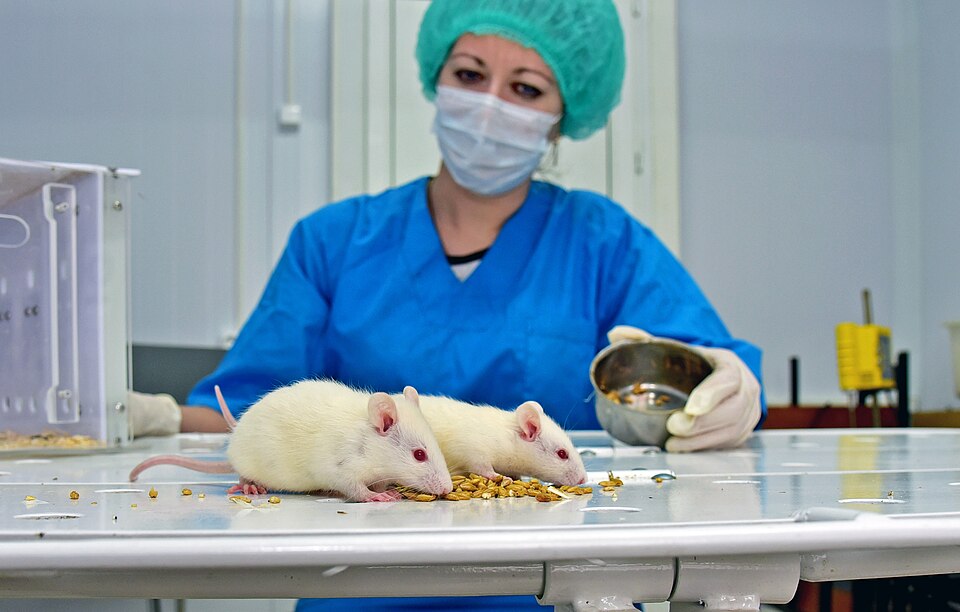
Several white laboratory mice in a clear plastic cage with bedding, one standing up against the side.
Laboratory mice, and the fourth place values get in. Rodent studies of how drugs affect behaviour use male animals almost exclusively, including for conditions commoner in women. The reason given is that hormone cycles in females add a variable that makes causes harder to isolate. Galina Fomina, CC BY 4.0, via Wikimedia Commons.
Example · four · choosing the model

The claim. A model represents some features and drops others, so building one is deciding what matters.

Male-only animal models. Rodent studies of drug effects use males nearly exclusively, despite evidence that drug metabolism differs by sex. And it holds even for conditions commoner in women: depression and anxiety disorders, stroke, thyroid disease, cardiovascular disease.

The reason given, and the two replies. The reason is that the female oestrous cycle adds a confounding variable that makes causes harder to establish. First reply: that assumption is itself doubtful on the evidence. Second reply, which is the philosophical one: choosing males for simplicity and predictive power treats those epistemic gains as worth more than the consequences for female patients, and that trade is a value judgment nobody wrote down. The consequence is diagnostic guidelines and treatments that fit women less well.

And the same shape in climate models. Models measuring the aggregate effect of climate change on food production can report that losses where drought hits are offset by gains in milder regions. True of the total, and it hides the distribution. Just policy needs to know who loses, and an aggregate is built so as not to say.

Example · five · interpreting data and weighing alternatives

The claim, and it is the sharpest one in the chapter. Whether a hypothesis is justified is a comparative judgment: it has to beat the alternatives. So anything shaping which alternatives occur to you also shapes how well supported your conclusion is. That is Okruhlik's argument, and it means a conclusion can be unjustified without any single step being wrong.

The rod and frame test again, now from Longino's angle. Week 6 gave Fausto-Sterling's objection: the test may measure willingness to keep making demands of a man in a dark room. Longino adds why nobody noticed. The researchers were overwhelmingly male and shared values and interests, so the design flaw was invisible from inside the group, and the alternative explanation never came up to be rejected.

And the result that settles it. When the experiment was altered to control for these variables, the difference in performance disappeared.

What replaces the value-free ideal, and the test any replacement has to pass

The question What has to be true of a replacement for it to satisfy feminists specifically?

The answer is four conditions: a replacement has to do the three political jobs the VFI was doing, and protect the science as well. A replacement has to answer:

  1. Does it matter who participates in science, and if so why? An epistemic reason, on top of a fair one.
  2. How can feminist values play a positive role, having only ever been the thing to be scrubbed out?
  3. How do we make sure the products of science benefit marginalised groups, given how reliably they have reinforced the arrangement?
  4. And how is the epistemic integrity of science protected once values are admitted?

Model one: value management

The question Can you let all values in and still get objectivity out?

The answer is yes, if the community is built right, and the building instructions are Longino's four norms. Rolin's name for the arrangement is the value-management model.

  1. There must be recognised avenues for criticism of evidence, methods, assumptions and reasoning.
  2. There must be shared standards that critics can appeal to.
  3. The community as a whole must respond to criticism.
  4. Intellectual authority must be shared equally among qualified practitioners.

The mechanism, in one line: you cannot see your own assumptions, and you can see somebody else's easily. So a community holding different values will catch what each member cannot.

It passes all four tests, which is why it is the mainstream answer. Diversity gets an epistemic job, so question one is answered. Feminist values can be the better-grounded ones in a given case, so question two is answered: if interventions ought to work as well for women as men, that is a reason against male-only animal models; if gathering is work, baskets are tools. Including people whose interests were absent changes what gets studied, so question three is answered. And shared standards plus live criticism protect integrity, so question four is answered.

Then the objection Intemann raises against her own preferred field. The model assumes a level field, and treats science as a place where any value may enter and be judged on equal terms. She lists what is wrong with that picture:

  • Research is increasingly privately funded, and funders decide what gets pursued, which methods regulators require, and what gets published. Pharmaceutical trials often retain the right to withhold negative results.
  • Manufactured dissent, which is week 5's Merchants of Doubt arriving from the other direction: privately funded scientists raise objections in order to stall policy, confuse the public and divert other scientists' time.
  • Who gets to participate at all is unequal before anybody reaches a laboratory. A third of United States schools are rural and a fifth of students attend one, and rural schools get less funding, less fast internet, and have more trouble keeping qualified science teachers.
  • And the culture inside the field excludes without any explicit discrimination: work demands incompatible with parenting, harassment, and a climate that makes staying undesirable even where nobody discounts your work.

So the objection is not that the four norms are wrong. It is that a model which depends on equal intellectual authority cannot deliver it in a world arranged like this one.

Model two: social justice

The question What do you add once you accept the field is not level?

The answer is an aim. The social justice model starts from a commitment: a central purpose of publicly funded science is to achieve social justice, meaning science should benefit everyone and particularly those who are worst off. Intemann presents it as an addition built on top of the first model.

What makes it different in one line: the management model is pluralist, letting all values compete. The social justice model prioritises some values over others before the competition starts.

The method attached to it has a name you should keep: studying up, or studying from the margins out. Five things it asks of a researcher:

  1. Work with members of the affected group to frame the problem.
  2. Identify everyone the problem affects.
  3. Ask whether the field's usual concepts serve all of them.
  4. Investigate how the problem shows up differently for different groups.
  5. Ask how systems of power contribute to it.

Why it answers question one better. People in marginalised positions are likelier to have evidence about how arrangements disadvantage them, and the line Intemann uses is the memorable one: privilege is easier to identify by those who do not have it.

And she does not pretend it is finished. Three questions she poses and leaves open:

  1. Are there competing conceptions of justice, and what happens when they conflict?
  2. Should all research aim at it, or can research be worth doing without advancing it?
  3. How is any of it applied to a concrete decision?
If you keep one thing. The value-free ideal was never only a mistaken description of science. It was doing work: it made diversity a question with no scientific stake, turned every documented bias into one team's lapse, and made who benefits somebody else's department. That is why removing it is a political act as well as a philosophical one, and why what replaces it has to answer who participates, whose values, who benefits, and what protects the science all at once.
Where it belongs in the quarrel
  • It completes week 6. Chapter 4 showed values enter at nine decision points. This asks which values should, and who decides.
  • It answers week 5's relativism objection in its strongest form: both models keep shared standards of evidence, so neither is the free-for-all the objection imagines.
  • It is answered by chapter 19 below, which says both models are academics arguing about academics.
  • It sets up weeks 8 and 9. Tremain on disability is the social justice model applied to a group, and the normalization material is how a category gets built in the first place.
My noteThis is the chapter to revise from, because it compresses the term. Be able to produce the five ways values enter, with one case each, and the two models with the one-line difference between them: management lets all values compete under four norms, social justice picks an aim first. The HRT case is the best opening example you have for any question about values, because it has three distinct kinds of judgment in one story. The 90 and 10 figure on biomedical funding is the kind of number an examiner likes. And note that Intemann is one of the two authors of the textbook from weeks 5 and 6, so her framing is the course's framing.
For the curiousnone of this is on the exam
The book that drove the HRT boom was paid for by the company selling it

Feminine Forever sold around 100,000 copies in its first year and was serialised in women's magazines. Robert Wilson's research foundation was funded by Wyeth, the pharmaceutical company making Premarin, the most widely prescribed form of the drug, along with other manufacturers. His son later said publicly that Wyeth had funded the book itself.

The chapter does not mention this, and it is worth knowing because it cuts both ways. It makes the case look like straightforward corruption, which would let the rest of science off. Intemann's point is the harder one: the value judgments she lists were made by ordinary researchers too, for decades after Wilson, by people with no cheque involved.

The 2002 trial was stopped early, and the fallout is still argued about

The Women's Health Initiative oestrogen-plus-progestin arm was halted about three years ahead of schedule because the monitoring board judged the harms had crossed a pre-set boundary. Prescriptions fell by roughly half within a year, worldwide.

Since then the picture has become more complicated in the direction the chapter describes: risk and benefit depend on which hormones, what dose, for how long, and how close to menopause the patient started, which matters most of all. Women starting under sixty appear to have a different risk profile from the trial's average participant, who was in her sixties. Which is the chapter's argument once more: an aggregate answer hid a distribution.

Emily Martin’s paper is one of the most reprinted in the field

"The Egg and the Sperm: How Science Has Constructed a Romance Based on Stereotypical Male-Female Roles", Signs, 1991. She went through the textbooks and tabulated the verbs. Sperm deliver, activate, penetrate; eggs are transported, swept, drift.

The biology that displaced it came largely from a Johns Hopkins laboratory finding that the sperm's forward thrust is weak and that it is the chemical interaction at the egg's surface that moves the sperm in. Martin's observation is that the new finding was reported with the egg as an aggressor, which is a different stereotype doing the same job.
CH 19Feminist Science for the People

Sara Giordano, in Crasnow and Intemann (eds), The Routledge Handbook of Feminist Philosophy of Science, Routledge, 2020
Read properly10 pp, printed pages 250 to 259
Why this chapter is set. It is the one that refuses the question the others are asking. Chapters 4, 5 and 15 debate how scientists should behave. This asks who gets to be one, and whether the push to include more people has mostly served the institution doing the including. It is the most radical thing on the reading list and the most likely to annoy you, in either direction.

What “public understanding of science” turned out to mean

The question When institutions say the public needs to understand science better, what are they actually asking for?

The answer, and it is the chapter's opening move: what is wanted is appreciation. Giordano's claim is that the literature itself says so, and she goes to the first issue of the journal to show it.

The deficit model
The public has a hole where knowledge should be, and filling it will produce support for science. Science studies has pushed against this for decades, which is where calls for democratic science come from.

Where the demand came from historically, and this is the part worth holding on to. It takes root after the Second World War, and it is tangled with nationalism. An assumption that science is good in itself did not survive the war. Who controlled it mattered.

The asymmetry Giordano puts plainly Germany could be condemned for unethical experimentation that harmed and killed millions, while the United States had to defend its use of the atomic bomb on hundreds of thousands.

So the push for a scientifically literate public was about national pride and national security, and the worry about science in the wrong hands runs from Cold War politics into the war on terror and into bioethics today.

Then the close reading she builds the section on. The first article in the first issue of Public Understanding of Science, 1992, by two policy advocates at a cancer research fund, argues scientists should get involved so the public will see them as normal people and trust them. It identifies two threats.

  • Unskilled working women, named as the hardest group to reach, who the authors assume get their information from television game shows and tabloids. The suggested remedy is putting a scientist into a soap opera.
  • Animal rights activists, and the way this is done is the thing to notice. The authors cite polls showing public distrust about animal research, and then set them beside a fear that people think scientific curiosity could produce a child with yellow eyes and three noses. Giordano's objection is that the connection is spurious, and that lumping a reasoned objection together with a fantasy discredits the objection by association.

And why she picks that article, when worse ones exist. It is the first article in the first journal of the field, so it set the terms. It also appeared alongside critical pieces in the same issue, which tells you the field was entangled with scientists and policy makers from the start.

Inclusion that leaves the system intact

The question Why would more people being let in fail to fix anything?

The answer: because the movements of the 1960s and 1970s were not asking to be let into the existing arrangement, and the version that survived was the one that asked for exactly that.

The reasoning in order. Those movements held that categories of race, gender, sexuality and ability were not inevitable but were doing work for the economic and political system. So the goal was to change the system, and not to admit a few people to it. What happened instead was that admitting some people from excluded groups let the system carry on and redrew the lines somewhere else.

Her two cases, and they share a pattern.

  1. Respectability. Conformity to white, heterosexual, middle-class norms about how a woman behaves and what family she lives in. It was used to justify withholding state support from poor Black women, by blaming individuals or culture.
  2. Same-sex marriage. The campaign won healthcare benefits for couples with jobs that provide healthcare, while leaving marriage itself unquestioned, so people without jobs or insurance stayed outside.

In both, the boundary moved, and the people on the far side of the new one became harder to see.

What that means for science. Calls to open science to everyone, made without correcting the inequality first, end up meaning everyone who is already economically successful. She calls this a colourblind and genderblind politics, and the objection is that we do not live in a raceless or genderless world, so a rule that ignores race and gender preserves whatever the existing distribution happens to be.

Illiteracy as resistance, the argument you will want to argue with

The question Is somebody who rejects a scientific explanation necessarily ignorant of it?

The answer the chapter defends: sometimes they know it and are refusing it, and that is a different thing.

The evidence she cites. Barr and Birke interviewed women about adult science education and found that some knew the scientific answers and chose other explanations. Emily Martin found that what looked like scientific illiteracy among working-class women was resistance to medical authority on menstruation. So the category ignorant was being applied to people making a choice.

Then the stronger version, which is where most readers get off. Lucía Egaña Rojas writes that a transfeminist technology will value illiteracy, for being unproductive for industry, as a way of finding paths that speed and productivity never imagine. The underlying observation: tying epistemic authority to literacy devalues the knowledge of most of the world's poorest people.

Example · what happens to anybody who says this out loud

The event. During the Fees Must Fall protests in South Africa in 2016, a student suggested that science is a colonial project and should be abandoned before something new is built. The video went round under #ScienceMustFall.

Giordano's point is about the response. Nobody argued with the suggestion. It was treated as evidence of ignorance, and then used to discredit the whole movement.

And the sentence that makes the argument serious. The people making the decisions that reproduce an unequal society every day are the best educated people in it. So more education cannot be the whole answer. She gathers five alternatives, each a way of working the deficit model has no room for.

  1. Unlearning
  2. Rewriting
  3. Unschooling
  4. Failure
  5. Illiteracy

What to do with this if you think it is wrong. Her own footnote concedes the obvious objection: this is no purist stance, and nobody is giving up medicine or phones. The narrow claim is that in specific cases refusing the scientific framing is a legitimate move. That narrow claim is the one to argue against if you want to, and the broad version is one she does not make.

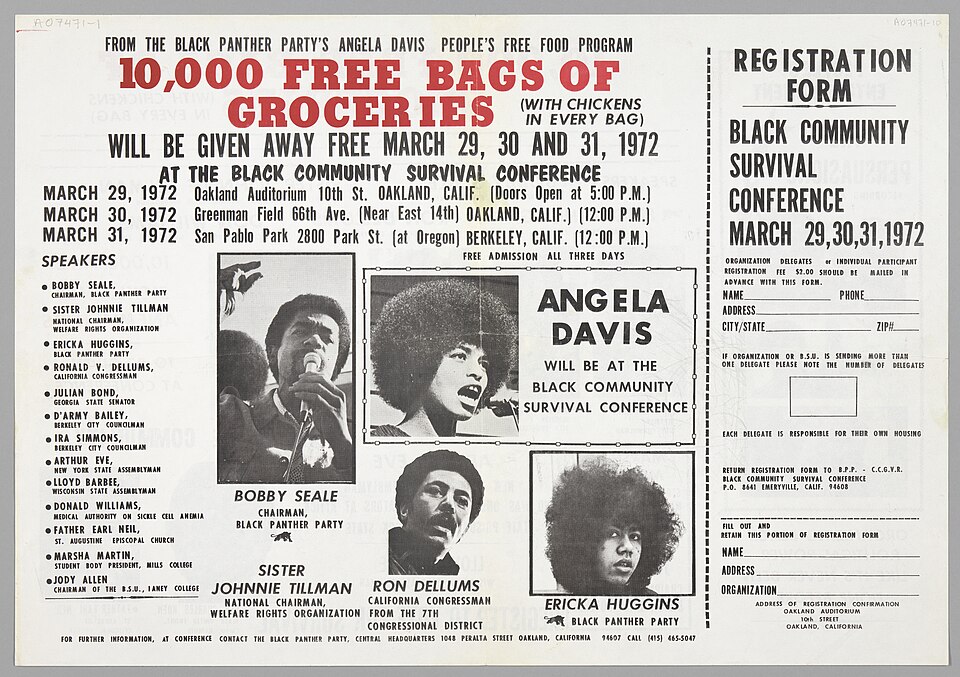
A 1972 flier for the Black Community Survival Conference, offering 10,000 free bags of groceries, with photographs of Angela Davis, Bobby Seale and Ericka Huggins and a list of speakers down the left side.
The Black Panther Party's Community Survival Conference, Oakland, March 1972. Giordano names the party's health work as democratic science that was already happening while the journals were discussing how to reach the public. Fourth from the bottom in the speakers list: Donald Williams, medical authority on sickle cell anaemia. The party ran mass screening for sickle cell at a time when the disease was medically neglected, alongside free clinics and its own criticism of racist scientific data. Black Panther Party, public domain, via Wikimedia Commons.

The Black Panthers, the health movement, and who else was already doing it

The question If the universities were asking how to reach the public, what was the public doing?

The answer: producing knowledge, in four movements she names, none of which was invited.

  • The feminist women's health movement, which made its own medical knowledge and distributed it, Our Bodies, Ourselves being the best-known product.
  • The Black Panther Party, which made health justice part of its platform: criticising racist scientific data, providing health information and medical services against a history of medical neglect, and running public education and testing for sickle cell anaemia.
  • The environmental justice movement, which from the 1980s collected its own data on environmental racism and built a movement that still works against corporate interests.
  • HIV and AIDS activists, who changed the way clinical trials are run and took a direct part in revising the definitions and the scientific facts of the disease.

And the question she asks of the field. Why were the people writing about public understanding of science not learning from any of these? Her answer: those initiatives never wanted a participatory relationship. They wanted attachment, appreciation and trust, and feminist disloyalty to science was one of the things they were worried about.

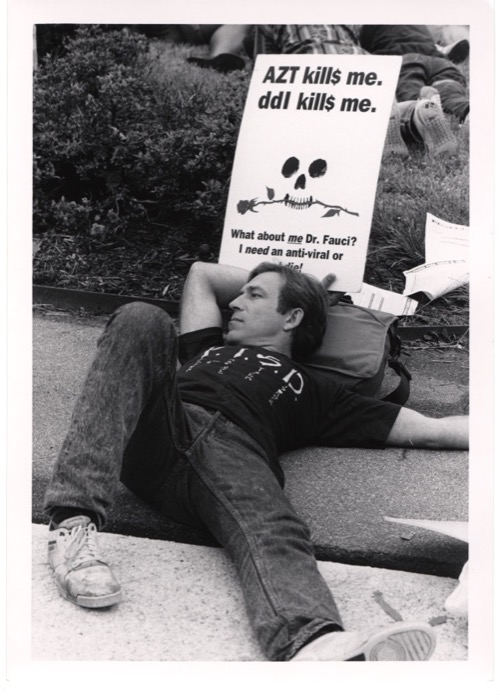
A black and white photograph of a man lying on a kerb at a protest, resting against a placard reading AZT kills me, ddI kills me, with a skull and the line What about me Dr Fauci? I need an anti-viral or I die.
ACT UP at the National Institutes of Health, 1990. The placard is an argument about trial design: both approved antivirals were failing this protester and he is asking why the research agenda does not include him. AIDS activists learned the pharmacology, sat on the committees and changed how clinical trials are run, which is Giordano's case that knowledge production outside the academy is a fact, and never a proposal. NIH History Office, public domain, via Wikimedia Commons.

The do-it-yourself biology labs, and who is actually in them

The question The do-it-yourself biology labs say they are opening science to everyone. Are they?

The answer from her own fieldwork: no, and what surprised her is that the participants were untroubled by it.

What she found. The rhetoric of open science for all is used to build support for these spaces. The people actually in them are overwhelmingly already scientifically trained, many holding academic posts or having worked in large biotechnology companies. Most are there to become biological entrepreneurs. The aim is freedom from the constraints of traditional research, and not a wider membership.

The detail that bothered her. The successes they highlighted were the ones that made a profit, and she had expected collective spaces that shared results and profits. Her word for her own reaction is puzzlement, and she traces it to a difference in what people mean by democratic.

A correction she makes to her own side Harding defines democratising science as making sure that those who bear the consequences of science policy have a proportionate share in making it, so that women's interests and values count. Giordano accepts the sentiment and rejects the category: treating women as a single group with shared interests has stood in for the interests of white middle-class women.
Medical apartheid
Harriet Washington's term, and the argument Giordano uses to make her correction stick. Some women, primarily Black women, have been used for the benefit of other women's health. The separation was neither unfortunate nor accidental: some bodies are undervalued so they can be used for the benefit of others.

What follows from that. Democratising science means counting the people whose bodies have been most subjected to the medical gaze, where counting women in general would leave the arrangement exactly as it is.

Her three worked models, briefly, since she gives them a paragraph each.

  • The science shop, from the Netherlands in the 1970s: a desk where community members bring research questions for graduate students to answer. It has drifted into a service for businesses, and feminists argue it could be run from a feminist studies department with an explicit commitment to justice.
  • Community-based participatory research. At its worst, the language is used to get free labour and community buy-in for research whose goals are still set by funders. Kim TallBear's objection is that it keeps the boundary between inside and outside the academy; her alternative phrase is standing with communities.
  • Public engagement, as in the Write2Know campaign in Canada, which argues for access to evidence about environmental toxins, political power for the people most affected, and the ability to produce new data in those communities.
If you keep one thing. Every other chapter this term asks how scientists should reason. This one asks who counts as a scientist, and answers it by pointing at people who produced real knowledge without permission: the Panthers on sickle cell, the women's health movement, the AIDS activists who rewrote trial design. Its warning is that opening a door changes nothing if the room stays the same, and that the inclusive version of a demand is often the version that survives because it threatens least.
Where it belongs in the quarrel
  • It attacks chapter 15 from the left. Both of Intemann's models assume science is something academics do and debate how they should do it.
  • It extends week 6's chapter 5. Agnotology asked how ignorance gets produced. This asks what gets called ignorance, and by whom.
  • It is answered by the obvious objection, that a movement cannot test a drug, and that the authority it attacks is partly earned. The chapter takes that in a footnote and narrows the claim.
  • It connects to week 8. Tremain on who gets defined as abnormal is the same move applied to disability.
My noteThis chapter will be the hardest to read, because it assumes vocabulary from critical race theory and decolonial studies that the course has not taught. Do not try to get all of it. The four things worth having are the deficit model, appreciation in place of understanding as what public understanding of science has meant, the four movements that produced knowledge from outside, and medical apartheid as the reason women cannot be treated as one group. If a seminar asks for a criticism of the course itself, this chapter is the one that supplies it.
For the curiousnone of this is on the exam
The AIDS activists really did change how drugs get tested

Steven Epstein's Impure Science, 1996, is the book the chapter cites. ACT UP's treatment and data committee taught itself immunology and trial statistics well enough to argue with the National Institutes of Health on its own terms, and then won several of those arguments.

Concrete results: parallel track, which let people take an experimental drug while trials continued, accelerated approval for drugs treating life-threatening illness, and a rewriting of trial entry rules that had excluded women and injecting drug users from the studies whose results would then be applied to them. Whatever you think of the chapter's larger claims, that is non-scientists altering scientific method and getting better science out of it.

The sickle cell story is more complicated and more interesting than either side says

The Panthers' screening programme reached tens of thousands and is credited with pushing sickle cell onto the federal agenda, resulting in the National Sickle Cell Anemia Control Act of 1972.

And the law went wrong in a way nobody intended. Screening in several states was made mandatory for Black citizens, carrier status was widely confused with having the disease, and people lost jobs and insurance because of it. The programme was substantially rewritten in 1976 to make testing voluntary. A movement forced a neglected disease into public science, and the institution that took it up produced a new harm, which is a sharper illustration of the chapter's argument than the chapter gives.

Science for the People was an actual organisation

The chapter's title is borrowed. Science for the People was a radical scientists' group founded in 1969 out of a walkout at a physics conference, which ran a magazine of the same name until 1989 and campaigned against military research funding, against sociobiology, and for community control of technology.

It was revived in 2014 and still publishes. Several people in the original group were working scientists at elite institutions, which complicates the inside and outside distinction the chapter draws.

CH 3Émilie Du Châtelet: Feminism, Epistemology and Natural Philosophy

Karen Detlefsen, in Crasnow and Intemann (eds), The Routledge Handbook of Feminist Philosophy of Science, Routledge, 2020
Read properly12 pp, printed pages 41 to 52
Why this chapter is set. Everything else this term argues that the position of the knower affects the knowledge. This is the cleanest case of it anybody has: a woman shut out of the French academy noticed that beliefs about women were held without examination, turned that into a general rule about belief, applied the rule to a scientific quarrel she had no stake in, and got the right answer about scientific method a century and a half before anybody else.

Three steps from being shut out to getting hypotheses right

The question Did being a woman make any difference to Du Châtelet's physics, or is she simply a woman who happened to do physics?

Detlefsen's answer: it made the difference, and the path from one to the other is traceable in three steps.

  1. She noticed that beliefs about women were held without ever being examined, and that she had suffered from it.
  2. She generalised that into a position about belief itself, which modern philosophy calls the ethics of belief: you have a duty to examine what you believe before believing it.
  3. She applied that rule to the biggest scientific quarrel of her day, saw that both sides were holding positions out of national loyalty, and so was free to take the correct middle position that neither side could reach.

And the correct position she reached is the one you were taught in school. Hypotheses are central to science. In 1740 that was close to heresy.

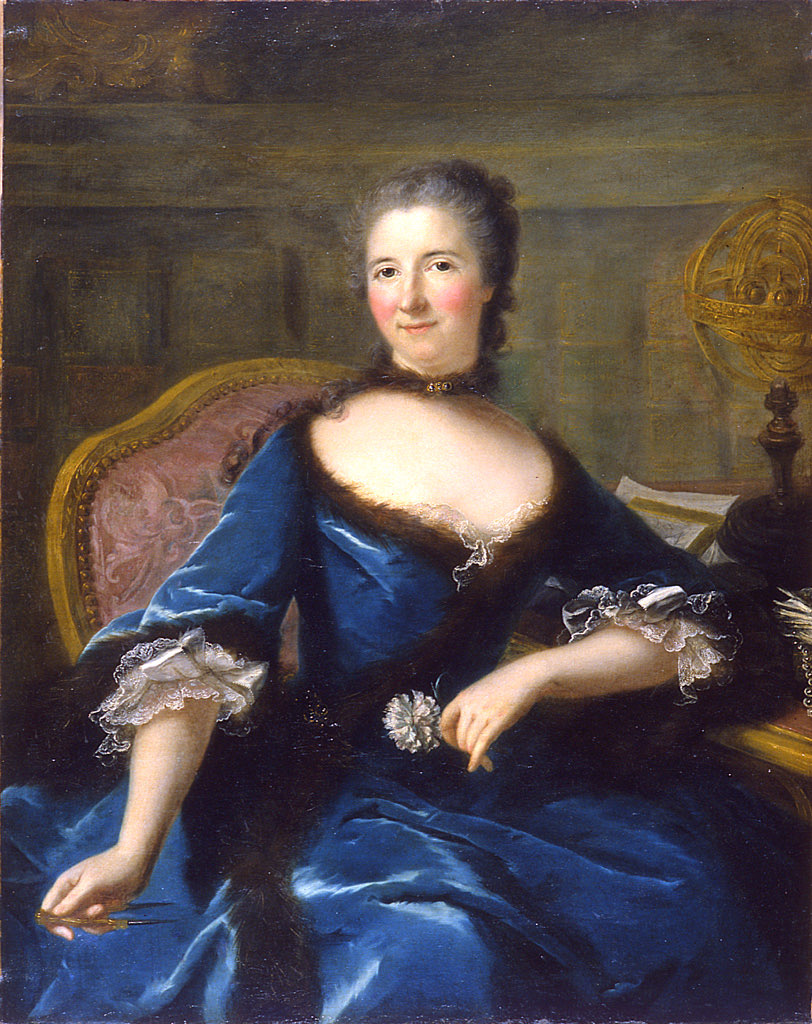
An eighteenth-century oil portrait of a woman in a blue silk dress with lace cuffs, seated at a desk holding a pair of dividers, with an armillary sphere and papers behind her.
Émilie Du Châtelet, 1706 to 1749, painted by Marianne Loir. Look at what she is holding: a pair of dividers, with an armillary sphere behind her and papers on the desk. Portraits of women of her rank did not usually carry instruments, and the painting is making the same argument she spent her life making. Marianne Loir, public domain, via Wikimedia Commons.

What she noticed about beliefs concerning women

The question she asks in the preface to her translation of Mandeville Why have women produced nothing?

And her answer is that the question is the wrong way round. She asks why, in so many centuries, no good tragedy, poem, history, painting or book of physics came from a woman, and says that these creatures, whose understanding appears in all things equal to that of men, seem to be stopped by an invincible force on this side of a barrier. She invites anybody to explain it.

Then she explains it. If she were king, she says, she would let women share in all the rights of humanity and most of all those of the mind. Women seem born to deceive, and their souls are scarcely allowed any other exercise. Many are either ignorant of their own talents, through flaws in their education, or bury them out of prejudice and for lack of a bold spirit. And she says that what she has experienced herself confirms it.

What makes this more than a complaint: she identifies a loop, and it closes.

  1. The belief that women are naturally frivolous
  2. produces institutions that give women nothing to do with their minds,
  3. which produces women who have done nothing,
  4. which confirms the belief.

And she names the part done from inside, where women take the prejudice on themselves and bury what they have.

Then the generalisation, from her Discourse on Happiness. A source of happiness is to be free of prejudice, and the decision rests with us to be rid of it. We all have enough intelligence to examine what others want us to believe.

Prejudice
Her own definition, and the usable one: an opinion accepted without examination, because it would be indefensible otherwise.

Her rule, and the company it puts her in

The question What does it mean to say you have a duty about what you believe?

The answer: that believing is something you do, so it can be done responsibly or not, and doing it badly is a fault, and never bad luck. The name arrived in 1877 with W. K. Clifford, whose version is absolute: it is wrong always, everywhere, and for anyone, to believe anything on insufficient evidence.

Du Châtelet is a century and a half earlier and in good company. Detlefsen sets three thinkers beside each other, and the useful observation is that each has a different authority in view.

  • Descartes aims at the Scholastics, arguing that human error is our own fault for assenting to what we have not examined clearly, which rots the foundations of the sciences.
  • Hume aims at religious authority, arguing in On Miracles that people set aside countless regularities of nature on the strength of one reported exception. A marble statue said to bleed outweighs every piece of marble that has never bled.
  • Du Châtelet aims at prejudice about women, and at national partisanship in science.

And what all three share, which is the sentence to take. A commitment to education for everyone, as the source both of evidence and of self-ownership of the mind, which is the best guard against authorities who use the gullible to spread untruths, whether about the natural world or about the social one.

How she passes it on. Her masterwork opens as a letter to her son. She tells him to accustom his mind early to think and to be self-sufficient, and then: whatever side you take in this dispute among philosophers, guard yourself against the obstinacy that the spirit of national partisanship produces, which is dangerous everywhere in life and ridiculous in physics.

The quarrel over hypotheses, and why both sides were getting it wrong

The question What was actually in dispute in European science in 1740?

The answer, in the framework Detlefsen uses: two camps, and the fight was about whether hypotheses are allowed at all.

Speculative natural philosophy
Reasons from principles about how things must be.
Experimental natural philosophy
Builds from experiment and observation. By the 1690s this side had hardened into opposition to hypotheses altogether, which is the part a modern reader finds strange.

What they meant by the charge. Newton: experimental philosophy reduces phenomena to general rules, while hypothetical philosophy consists in imaginary explications of things and imaginary arguments for or against them, and he follows the first while Descartes and Leibniz follow the second too much. A contemporary dismisses the systems of Descartes, Gassendi and Hobbes as possibly chimeras and amusing notions, fit to entertain working heads.

And the nationalism riding on top of it, which is why her rule is relevant. Voltaire's Elements of Newton's Philosophy draws a bright line between the old French way of hypotheses and the new British hard-headed experimentalism, and tells the French to catch up. So the scientific question had an English answer and a French answer, which is exactly the situation her letter to her son is about.

One piece of context worth having, because it changes who she is. For decades her thought was treated as derivative of Voltaire's, with whom she lived and worked. Detlefsen calls that claim evidence-free, and says close examination of her work has debunked it. Her treatment of hypotheses is the example: she does not agree with him.

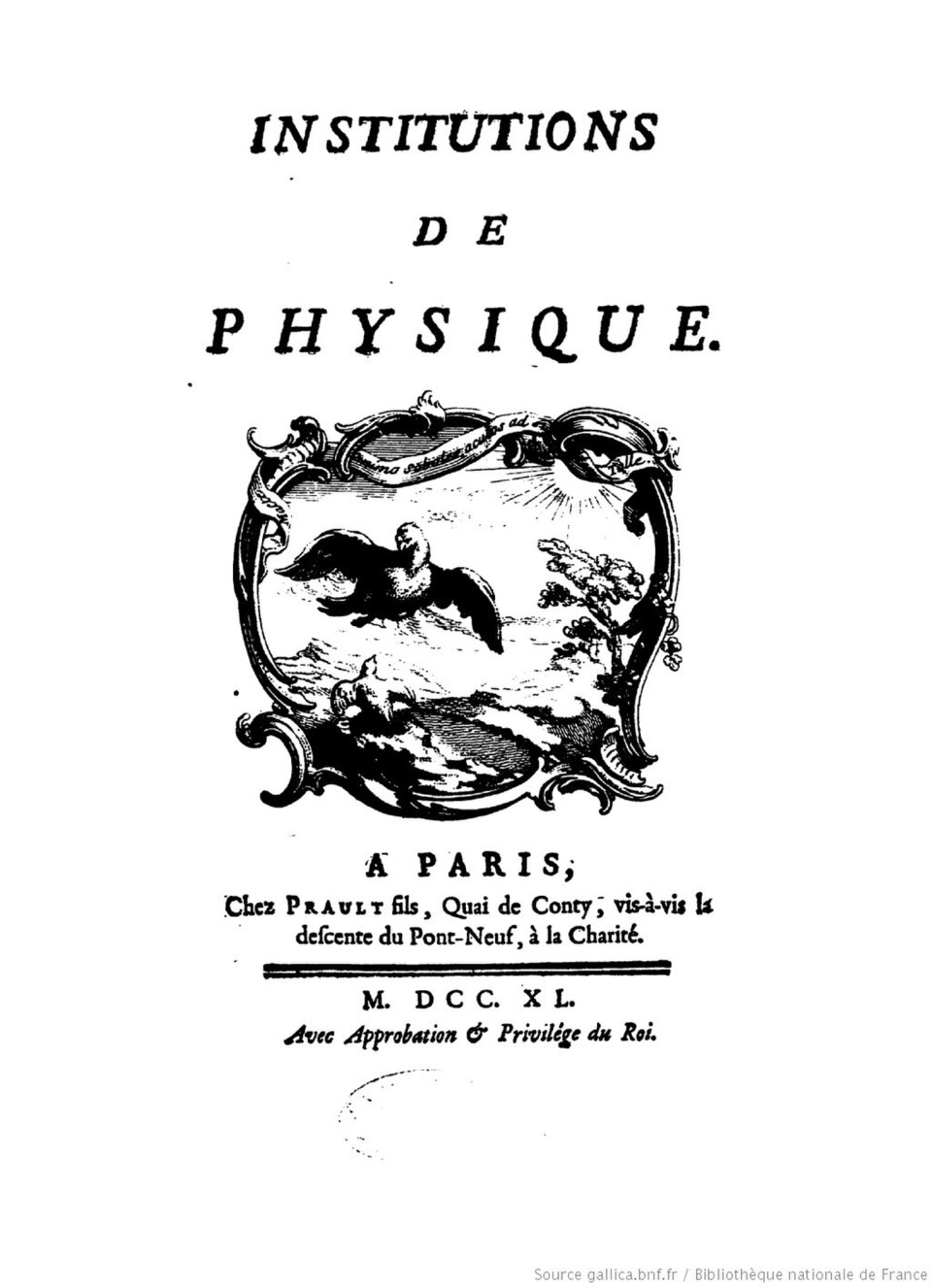
The 1740 title page of Institutions de Physique, printed in French with a decorative engraved headpiece, giving the place of publication as Paris and the date MDCCXL.
The title page of Institutions de Physique, Paris, 1740. Her name is not on it. The book was published anonymously, presented as a physics textbook for her thirteen-year-old son, and chapter 4 of it is the account of hypotheses that the field would take another century and a half to arrive at independently. Public domain, via Wikimedia Commons.

What she actually said about hypotheses

The question If a hypothesis is a guess, why should science be allowed them?

Her answer: because there is no other way to reach a cause you cannot observe and cannot derive, and the fix is to constrain them, where everybody around her wanted them banned. This is chapter 4 of the Foundations, and the four constraints she sets are, in substance, the modern ones.

First, why they are necessary. Hypotheses are needed in all cases where the true reason for a phenomenon cannot be discovered either in advance, from truths already known, or afterwards, from experiment. That gap is permanent, so the tool is permanent.

Her flat version of it Without hypotheses there would be no astronomy now.

And the argument from who used them. Copernicus, Kepler, Huygens, Descartes, Leibniz and Newton himself all devised useful hypotheses to explain difficult phenomena.

So, she says, those who want to ban them from philosophy intend harm to the interests of science. Her target is anybody leaning too hard on Newton's famous line that he feigns no hypotheses.

Then the constraints, which are what make the account modern.

  1. Test them. Once a hypothesis is posed, experiments get done to find out whether it is a good one, experiments which would never have been thought of without it. That is the hypothesis earning its place by generating work.
  2. One falsifying observation kills it. A hypothesis becomes false when it is found to contradict a well-established observation. That is falsification, stated plainly, two centuries before Popper gave it a name.
  3. Fruitfulness counts. A good hypothesis explains the phenomenon it was built for and its further consequences agree with observation.
  4. Be modest, and take it apart before throwing it out. A hypothesis can be true in one of its parts and false in another.

Her fourth constraint has teeth, because she uses it against the winning side. Descartes explained gravity with vortices, and by her time the idea was held in contempt because Newton's account had won. She will not have the wholesale rejection: it cannot legitimately be concluded that a vortex, or several vortices conceived differently, cannot be the cause of these movements. That is the ethics of belief applied to an opinion everybody around her held.

And her conclusion, which is the passage to know. Hypotheses are only probable propositions, more or less probable according to how many of the attendant circumstances they account for. A very high degree of probability has nearly the effect on us of certainty, so hypotheses eventually become truths for us when the probability rises far enough. A hypothesis becomes improbable in proportion to the circumstances it fails to explain, and false when it contradicts a well-established observation.

What is remarkable about that is not the content but the date. Degrees of probability, falsification by a single result, and theories that are accepted without being proved. That is roughly the twentieth-century account, written in 1740 by somebody the Académie would not admit.

If you keep one thing. Du Châtelet got the right answer about hypotheses because she was the only person in the room with no stake in the fight. Both camps were defending national positions; she was excluded from the institutions that made those positions worth defending, so she could ask which parts of each were true. That is the standpoint argument of weeks 5 and 6, demonstrated in 1740 by somebody who arrived at it herself, starting from noticing that nobody had ever examined what they believed about women.
Where it belongs in the quarrel
  • It is week 6's standpoint theory as a historical case. Harding's inversion thesis says the excluded see the assumptions of the included. This is a worked example with a date on it.
  • It answers week 2. That packet argued about what the scientific method is. She settles the part about hypotheses, and settles it correctly.
  • It answers week 3. Her falsification rule is Popper's, long before Popper, and her modesty about vortices is the anti-dogmatism Kuhn said paradigms prevent.
  • It is answered by the suspicion that this is hindsight, picking the one eighteenth-century figure who agrees with us. Detlefsen's defence is that her method was explicit and general, and that she applied it against her own circle's consensus.
My noteThe easiest reading of the term and the best value for revision time. Four things: the ethics of belief and her definition of prejudice as an opinion accepted without examination; the speculative against experimental divide and the strange fact that the experimental side opposed hypotheses; her four constraints, of which falsification is the one to name; and the loop she identifies, where a belief about women produces the conditions that confirm it. If an exam asks for an example of standpoint theory, she is a better answer than the primatologists, because the mechanism is visible: excluded from the institutions, therefore free of their loyalties.
For the curiousnone of this is on the exam
She translated Newton and it is still the French edition in print

Her translation of the Principia into French, with a commentary that rewrites Newton's geometry into the calculus of Leibniz and adds the results of the intervening fifty years, was finished in 1749 and published in 1759. It is still the standard French translation.

She was working against a deadline she knew about: she was pregnant at forty-two, believed she would not survive the birth, and wrote through the nights to finish. She died of an infection six days after the delivery. The commentary that makes the translation important was the part she was racing to complete.

She published her prize essay on fire anonymously, and so did Voltaire, against each other

In 1737 the Académie Royale des Sciences set a prize on the nature of fire. Voltaire entered. Du Châtelet entered separately and in secret, without telling him, after concluding his approach was wrong.

Neither won, and the Académie published both essays, which made her the first woman to have a paper published by it. Her essay suggested that heat and light might be forms of the same thing and that different coloured lights would carry different heating power, which is a guess in the right direction about infrared radiation, found experimentally by Herschel in 1800.

She was barred from the café where the physicists met, so she dressed as a man

The Café Gradot in Paris was where the mathematicians and natural philosophers gathered, and it did not admit women. The story, from contemporaries, is that she was turned away, went to a tailor, had men's clothes made, and walked back in. The staff let her sit.

Ancient gossip levels of reliability apply to the details. The underlying fact does not: the institutions where the arguments happened, the cafés and the Académie, were closed to her, which is Detlefsen's whole point about why she could see what the men in them could not.

CH 20Feminist Philosophy of Biology

Lynn Hankinson Nelson, in Crasnow and Intemann (eds), The Routledge Handbook of Feminist Philosophy of Science, Routledge, 2020
Read properly12 pp, printed pages 263 to 274
Why this chapter is set. It is the worked example for the whole of last week. Chapter 4 asked where a value can enter a piece of research and chapter 5 asked how ignorance gets produced, and this is both of them happening to one science across 150 years. Its second case study is the full version of the primatology story week 5 opened with. The first three pages are a survey and can be read quickly. The two case studies are the reason it is on the list.

Four faults to look for in a piece of biology

Nelson names the things feminists go looking for in biological research. The first three are worth having as a checklist, because they turn up in every case the chapter discusses.

  • Androcentrism, meaning male-centredness. Research that takes the activities and dispositions associated with males as the main thing to study, and does not properly attend to those associated with females.
  • Gender stereotypes. A generalisation that attributes a characteristic to every member of a group when it is untrue of many or most. Her example: females associated with reproduction, which gets treated as natural and therefore as not needing study, while males are associated with providing, protecting and dominating.
  • Gendered metaphors. Metaphors are fine in science so long as everybody remembers they are metaphors. The problem is when the metaphor gets taken literally and starts doing argumentative work.
  • Background assumptions, which is Longino again, and Nelson points out the idea is not originally feminist: Carl Hempel argued in the 1960s that unexamined background assumptions can lead good reasoning to unwarranted conclusions.

One terminological note worth knowing. Nelson writes sex/gender in place of gender for human cases, because the evidence is that neither is stable or unaffected by the other. The quotation she gives: it is impossible to disentangle the effects of sex from those of gender, since bodies, brains included, change in response to environments and experience.

Nelson's four faults to look for in biological research, each with what it means and the place in her own chapter where it turns up. THE FAULT WHAT IT IS WHERE IT SHOWS UP HERE 1  Androcentrism Male-centredness. Research takes what males do as the main thing to study and lets the rest go. The baboon reports, built on male dominance, with what the females did never recorded. 2  Gender stereotypes A characteristic attributed to every member of a group when it is untrue of many of them. Darwin’s eager males and coy females. Females tied to reproduction, so left unstudied. 3  Gendered metaphors Fine while everybody remembers they are metaphors. The fault is letting one do the arguing. Sperm is cheap and eggs are expensive, which settles the question it was meant to raise. 4  Background assumptions Longino’s, and not originally feminist: Hempel said in the 1960s that unexamined ones mislead. That a female and her young need help from a male, which fieldwork keeps contradicting.
The checklist, and the chapter using it on itself. The first three are the ones to carry into any piece of research, and the right column shows that the two case studies below are the same four faults twice over. The fourth is highlighted because it is the one that is not feminist in origin and the one the other three reduce to: a male-centred question, a stereotype and a metaphor are all background assumptions that nobody examined. Hempel was making the argument in the 1960s with no feminism in it at all, which is the reply to anybody who says the critique is political before it is epistemic.

The peacock’s tail, and what Darwin built to explain it

Start with natural selection, because sexual selection was invented to patch a hole in it. Darwin's argument: members of a species vary; there is a struggle for existence; so a variation that helps survival even slightly makes its holder likelier to survive and pass it on; and enough accumulated variations make a new species. He was clear about the consequence: any trait that hurt survival would have to be selected against.

The hole. The peacock's tail is enormous, bright enough to attract predators, and heavy enough to stop the bird running or flying away. Peahens have small brown tails. More generally males of many species are brighter and bigger than females, which looks like a disadvantage in surviving. So why has natural selection permitted it?

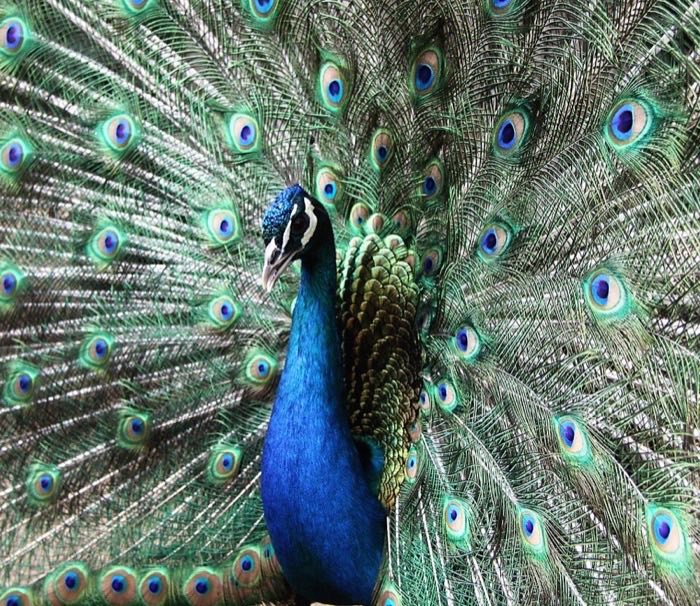
A peacock seen from the side with its long iridescent blue and green train of tail feathers trailing behind it on grass.
The problem Darwin could not leave alone. A train this size is visible to predators and makes escape harder, so on his own account of natural selection it should have been eliminated. Sexual selection was built to explain this one kind of thing, and the picture of eager males and reluctant females came in with it as part of the machinery. Memurubu, CC BY-SA 4.0, via Wikimedia Commons.

Darwin's patch: sexual selection. These traits are about reproducing where natural selection was about surviving, and survival is necessary for evolution without being sufficient. His definition from The Descent of Man, 1871: the advantage which certain individuals have over others of the same sex and species, in exclusive relation to reproduction. It works by two processes:

  1. Males compete with each other for access to females. Large size helps here.
  2. Females choose. Bright colour helps here, and the tail is explained.

Then the part that has nothing to do with tails. Darwin did not give human females mate choice, saying men make those choices, and Nelson traces the reasoning to Victorian England and to views about the sexes going back to Aristotle. He also claimed sex differences in behaviour and psychology: males generally eager to mate with any female, females less eager and, in the Descent, coy.

And a list of male advantages with a cause attached. Stronger passions, higher intelligence, greater strength, better senses and better movement, all caused by the selection pressures he thought males alone faced: competing for mates, providing and protecting, defending the community. Women have some of these qualities, he allowed, to a far lesser degree, and only because they inherit them from men.

Ruth Hubbard's line, which is the one to remember On Darwin's account women have enjoyed a free evolutionary ride on the backs of their male conspecifics.

What feminists did to it. Nelson is precise about the targets. That a female's survival and her offspring's depend on help from males is an unwarranted stereotype, and field biologists give counter-examples from the species they watch. The claims about differences in intelligence and reason were not needed to solve the peacock problem at all, and they track the social views of the time far more closely than they track the biology. And females of many primate species are nothing like coy or passive.

The 1972 reinforcement, and the current target. Robert Trivers proposed parental investment theory and argued it explained and supported Darwin. The claim: the sex that invests more in offspring will be choosier. He argued that in most species the male's only contribution to his offspring's survival is his sex cells, while female contributions exceed male by a large ratio, because of gametic dimorphism, the difference in size and number between sperm and eggs, plus gestation, lactation and egg-sitting. The slogan version is that sperm is cheap and eggs are expensive.

Three objections Nelson reports, and the first two are empirical.

  1. Males contribute more than sperm. Males of many species produce accessory secretions as well, and a proper accounting of investment would have to count them.
  2. Sperm is not cheap in bulk. High sperm production is generally needed for insemination to work at all, and in humans and others males produce millions of sperm per egg.
  3. The words are doing the arguing. This is the gendered-metaphor fault from her own list: investment, cheap and expensive are economic terms applied to biology, and they smuggle a conclusion in with the vocabulary.
A human egg cell and a human sperm drawn to the same scale, the egg about a hundred and twenty micrometres across and the sperm head about five. DRAWN TO THE SAME SCALE egg about 120 micrometres across head about 5 micrometres, whole cell about 55 sperm
Sperm is cheap and eggs are expensive, drawn. The size difference is real and it is what parental investment theory is built on: the sex that invests more will be the choosier one. Nelson's objection is not that the picture is false. It is that three economic words, investment, cheap and expensive, were laid over it, and those words answer the question the measurement was supposed to raise. A male produces millions of these per egg, and whether that adds up to less investment is the thing in dispute, which the vocabulary settles before anybody counts.
Uncritical acceptance of [sexual selection's] ubiquitous occurrence does no service to evolutionary theory. Heritable variance in reproductive success, based on characters that are not favored by natural selection, must be demonstrable before sexual selection may be invoked unequivocally.Spencer and Masters, 1992, p. 301

And a point that stops this being only a feminist complaint. Ernst Mayr, one of the major evolutionary biologists of the century, thought sexual selection did very little and that the traits it covered could be explained by natural selection anyway. The objection is not uniquely political.

The baboons, and the primate pattern that came off them

Why primates get studied for this at all. Humans differ from each other in about 0.1 per cent of their DNA. Humans and chimpanzees differ by about 1.2 per cent, humans and gorillas by about 1.6 per cent, and the split from a common ancestor is put at around six million years ago. So it looks reasonable to study their evolution to learn about ours, and some researchers go further and treat them as showing a basic human nature underneath the overlay of culture.

The 1960s and 1970s studies. Groups of anthropologists ran long field studies of savannah baboons in the Serengeti. They proposed a primate pattern: the behaviour and social structure they saw in savannah baboons was taken to be typical of most primates, produced by selection pressures common to all of them.

A large male yellow baboon sitting upright on a boulder in front of green scrub, facing the camera.
A male yellow baboon in Amboseli National Park, Kenya, where Jeanne Altmann worked. This is what the first generation of fieldworkers spent their time watching, and the drama between males is what their reports were built around. Altmann's argument was that it is the less visible business of the females that actually drives the group. Diego Delso, CC BY-SA 4.0, via Wikimedia Commons.

Three things Irven DeVore and Sherwood Washburn said were in the pattern.

  1. Male dominance, which they called the most important feature of baboon social structure, organising and controlling the group the way political leadership does in human societies.
  2. A division of labour by sex. Males provide, protect and maintain the structure that benefits everyone, while females take primary responsibility for the young.
  3. Male aggression, recorded as a trait of the species and attributed to men as well.

And the loop closes. Because early humans were thought to have evolved in the African savannah under similar conditions, similarities between the two species were taken to be likely, so the baboon findings were read straight across to human behaviour. Male dominance in baboon troops was set beside men's dominance over women.

Jeanne Altmann, and what happened when somebody watched the females. She worked for years on the Amboseli baboons in Kenya. Asked by Donna Haraway why she focused on females, her answer was that her self-identity as a scientist, a feminist and a mother led her there, and then: it was screaming at me. These are the most interesting individuals, interactions between baboon mothers and offspring have the most evolutionary impact, this is where the ecological pressures are.

Three findings, and the third undoes the original picture.

  1. Mothers run several things at once. Altmann described them juggling competing priorities and budgeting their time, and their dealings with juveniles and with other adults turned out to be key to the group's social dynamics.
  2. Adult males deal with infants a great deal. The first generation of fieldworkers had recorded almost none of this.
  3. Females build special relationships with particular males, who then protect them from other baboons. Hrdy's summary: infants are often the focal point of elaborate male, female and infant relationships, relationships often initiated by the females themselves.
Altmann's conclusion, stated against the field she was in The high drama of encounters between male baboons matters far less to the social dynamics of the group than the micro-practices of the females.

A methodological detail worth noticing. Altmann told Haraway that her reports on the females contained no category called child care, because she could not find a way of separating the females' activities that would produce one. The category was imported from human arrangements and the animals did not have it.

And Hrdy, which is week 5's opening told properly. From her studies of hanuman langurs and rhesus monkeys: a polyandrous component is at the core of the breeding systems of most troop-dwelling primates, polyandrous meaning females who mate with more than one male. Females mate with many males, each of whom may contribute a little to the offspring's survival.

What all this proves, and the two debates about it

First debate: was the old research simply bad science?

What hangs on the answer. If it was bad science, feminist critique tells you nothing about how science works, only that these particular people were careless. The studies were in keeping with the accepted hypotheses, priorities, methods and norms of their fields, and the scientists gave the evidence they recognised its due.

Nelson's answer, and it is the most important sentence in the chapter The work was not careless. There was more evidence, and different evidence, to be considered.
Second debate: did feminism actually cause the change?

Two rival explanations are on offer, and both deny feminism any credit.

  1. Science self-corrects. New evidence would have overturned the androcentric hypotheses sooner or later, whoever was in the room.
  2. Coincidence. Women influenced by the women's movement happened to arrive in these fields just as the thinking about gender was changing anyway.

Hrdy on the coincidence story, and it is a good line. She seriously questions whether chance or sequence caused a small group of primatologists in the 1960s, who happened to be mostly male, to focus on male competition and on how many matings a male achieved, while a later group including many women, from the 1970s, shifted the focus to female behaviours with long-term consequences for infants.

And the serious reply to the self-correction story. Theories do change in the face of new evidence, so the mechanism is real. In these cases, though, the people who built the androcentric hypotheses were never the ones who saw the problem. The new arrivals were. And biologists including Altmann and Hrdy say in their own words that feminism is what let them see it.

The complication Nelson states against her own case There are women in evolutionary biology, developmental biology and primatology who accept that their fields changed and reject any role for feminism in it. Linda Fedigan's explanation is that many primatologists, women included, see feminism as something outside science, and treat it as a purely political perspective incompatible with doing science well.
If you keep one thing. The baboon studies were not bad science by the standards of their time: respected work, proper methods, peer reviewed. What they had was a short list of things worth watching, and male dominance was on it while what the females did was not. Then women arrived, watched the females, and the central finding reversed. That is why the question is not whether scientists are careful but who they are, because care cannot recover evidence nobody went looking for.
Where it belongs in the quarrel
  • It is chapter 4 in one field. Phase 3, which observations count, is exactly what DeVore and Washburn got wrong, and phase 8, the alternatives nobody considered, is exactly what Altmann supplied.
  • It is chapter 5 in one field. What female baboons were doing was unknown for decades, and the ignorance was produced by neglect, which is strategy one.
  • It finishes week 5's opening. The langur anecdote at the start of chapter 1 is this, with the evidence attached.
  • It is answered by the self-correction argument, which says science would have got there anyway, and Hrdy's reply is the chapter's best paragraph.
My noteSkim the first three pages and the last two, and read the two case studies properly. The exam-usable material is: the four faults (androcentrism, gender stereotypes, gendered metaphors, background assumptions), why sexual selection was invented, which needs the peacock, parental investment theory and the sperm is cheap objection, and the Altmann and Hrdy findings against the primate pattern. The one philosophical claim to take out of it is Nelson's refusal to call the old work bad science, because that is what makes the case bear on how science works at all, over and above how these particular people worked.
For the curiousnone of this is on the exam
Altmann’s real revolution was a sampling method

Her 1974 paper "Observational Study of Behavior: Sampling Methods" is one of the most cited papers in animal behaviour, and it is about bookkeeping. Fieldworkers had been recording whatever caught their attention, which systematically over-records rare dramatic events and under-records the constant undramatic ones. She set out focal animal sampling: pick one animal, watch it for a fixed period, record everything it does whether or not it is interesting.

That is the method that made the females visible, because fights are noticeable and a mother budgeting her afternoon is not. It is a clean example of chapter 4's phase 4: changing how the data is collected changes what there is to interpret, and no amount of care at phase 5 could have recovered it.

The peacock's tail stayed a problem for a long time

Darwin's explanation needed peahens to prefer the biggest trains, which was not tested properly until the 1990s. Marion Petrie's work then found that peahens do prefer males with more eyespots and that their chicks survive better, which supported him.

A seven-year Japanese study published in 2008 then found no evidence that peahens preferred more elaborate trains at all, and the authors suggested the train may be an obsolete signal. The argument is not settled. Which is worth knowing, because the textbook example of sexual selection is less secure than the textbooks make it sound.

Haraway wrote the book on all of this

The Altmann interview Nelson quotes is from Primate Visions, 1989, Donna Haraway's history of twentieth-century primatology. Its argument is that primatology is a field where scientists have repeatedly gone looking for the origins of human nature and found whatever their own society was arguing about: the baboon troops of the 1960s look remarkably like the family and workplace arrangements of the 1950s.

The book was attacked on publication for implying that primatology is only politics. Haraway's reply is the position from the week 5 guide: saying knowledge comes from somewhere is not saying it is worthless, it is saying you should be able to name where.

Glossary

Every term in this guide, defined29 of them

Values in sciencech. 15

the value-free ideal, VFI
Social, moral and political values must play no part in the core of science: deciding what counts as evidence, which theory it supports, and what to accept. Douglas calls that core the heart of scientific reasoning. Everything this week attacks it.
non-epistemic values
Moral, political, social and economic values, held to be distinct from the aims of knowing. The VFI is about keeping these out, and it grants that some values, such as valuing prediction or empirical adequacy, are part of the enterprise.
the three jobs the VFI did
It made diversity a question with no scientific stake, turned documented bias into isolated bad science, and made who benefits somebody else's department. Intemann's reason feminists attacked it, where correcting it would have done for anybody else.
the five entry points
Framing the problem, observing and describing, value-laden concepts and risk, choosing models, interpreting data and weighing alternatives.
significant truths
Kitcher. Science chases truths somebody thinks worth having, so somebody decides. The 90 and 10 figure on biomedical funding is the case.
theory-ladenness
Observation is shaped by background assumptions, and those assumptions can be social. Martin on the passive egg and the burrowing sperm.
the value-management model
Rolin, from Longino. Any values may enter, and a sufficiently diverse and critical community catches the damaging ones. Objectivity is a property of how the community is run.
Longino’s four norms
Recognised avenues for criticism; shared standards critics can appeal to; a community that responds to criticism; intellectual authority shared equally among qualified practitioners.
manufactured dissent
Privately funded researchers raising objections in order to stall policy, confuse the public and divert other scientists' time. The Merchants of Doubt strategy, named as an obstacle to the management model.
the social justice model
Publicly funded science should aim at benefiting everyone and especially the worst off. It prioritises some values before the argument starts, where management lets all values compete.
studying up
Studying from the margins out: working with the affected group to frame the problem, identify everyone affected, and ask how power contributed to it.

Science for the peoplech. 19

the deficit model
The assumption that the public has a hole where knowledge should be, and that filling it produces support for science. The thing science studies has spent decades pushing against.
appreciation in place of understanding
Giordano's charge that public understanding of science has mostly meant building trust and attachment, and that the literature says so itself.
democratic science
Broader participation in knowledge production. Her warning is that the phrase is used by do-it-yourself biology spaces whose members are already scientifically trained and mostly want freedom to become entrepreneurs.
science illiteracy as resistance
Some people know the scientific explanation and choose another. Barr and Birke, and Martin on menstruation. The claim is narrow and the footnote says so.
medical apartheid
Washington. Some women, primarily Black women, have been used for the benefit of other women's health, and the separation is necessary to the arrangement, and never accidental. Her reason women cannot be treated as one group.
standing with
TallBear's alternative to community-based participatory research, which she argues keeps the boundary between inside and outside the academy in place.

Du Châteletch. 3

the ethics of belief
Believing is something you do, so it can be done responsibly or not. Named by Clifford in 1877; practised by Du Châtelet from the 1730s.
prejudice
Her definition, and it is usable: an opinion accepted without examination, because it would be indefensible otherwise.
speculative and experimental natural philosophy
The two camps of early modern science. By the 1690s the experimental side had hardened into opposition to hypotheses, which is the position she refused.
her four constraints on hypotheses
They must generate experiments; one well-established contrary observation kills one; a good one explains more than it was built for; and a hypothesis can be true in one part and false in another.
self-sufficiency of the mind
What she tells her son to cultivate, and what the ethics of belief requires: thoughts that belong to you, free of national partisanship and anybody else's authority.

BiologyNelson

androcentrism
Male-centredness. Research that takes what males do as the main thing worth studying and does not properly attend to what females do.
gender stereotype
A generalisation attributing a characteristic to all members of a group when it is untrue of many or most. Nelson's case: females tied to reproduction, which then looks natural and so not in need of study.
sexual selection
Darwin's second mechanism, built to explain traits that hurt survival, such as the peacock's train. Two processes: males compete for access, and females choose.
parental investment theory
Trivers 1972. The sex that invests more in offspring will be choosier, because of gametic dimorphism, the difference in size and number between sperm and eggs. The slogan is sperm is cheap and eggs are expensive.
the primate pattern
What the 1960s savannah baboon studies proposed: male dominance, a division of labour by sex, and male aggression, taken as typical of primates and read across to humans.
micro-practices
Altmann's term for the business of the female baboons, which she argued drives the group's social dynamics more than the high drama between males.
polyandrous
Of females who mate with more than one male. Hrdy's finding is that this is at the core of the breeding systems of most troop-dwelling primates.
Where this goes. Week 7 of thirteen, and the last week before reading week:
Oct 25 to 31
Reading week, no classes
Weeks 8 to 9
Nov 2 to 11. Feminist philosophy of disability. Tremain, Foucault and Feminist Philosophy of Disability, ch. 1 groundwork (p. 1) and ch. 2 power and normalization (p. 47), then ch. 5 bioethics as a technology of government (p. 159) · Exam 2, Wed 11 Nov, 30%
Weeks 10 to 12
Nov 16 to Dec 1. Animal minds, human and non-human. Andrews, The Animal Mind
Week 13
Dec 7 to 9. Review and exam prep · Final, 40%, date set by the Registrar
Sources. All four chapters from Sharon Crasnow and Kristen Intemann (eds), The Routledge Handbook of Feminist Philosophy of Science, Routledge 2020, through the uOttawa library: Detlefsen on Du Châtelet, pages 41 to 52; Intemann on values in science, pages 201 to 215; Giordano on science for the people, pages 250 to 259; Nelson on biology, pages 263 to 274. Page numbers are the printed ones, and none of the four carries a figure of its own.
Lecture notes