PHI2394Written with Claude|AI can make mistakes
PHI 2394 B00 · reading for Monday 21 September

Kuhn’s Paradigms, and Foucault’s Tower

Two short readings that answer the same question from opposite ends. Kuhn asks what makes a scientific community change its mind. Foucault asks what the machinery for knowing people is actually for. Sismondo chapter 2, pages 12 to 22 and no further, plus Panopticism from the packet.

11pages of Sismondo, and no more
11pages of Foucault, already in the packet
2texts, and they answer each other
7 OctExam 1, 30%, covers everything to that date

My notes

These stay in this browser. Your notes, highlights and bookmark are saved on the device you are using and survive a reload. They do not travel to another computer, they are not sent anywhere, and clearing your browsing data removes them.

The argument overallboth texts
KuhnSismondo ch. 2
Foucaultch. 54

The reading

The Sismondo chapter is narrated first, page by page, because that is the assigned text. Under it sits background on Kuhn himself, which the chapter assumes you have. Foucault is narrated in full at the end, moved here from the week 2 guide because this is the week he is set for.

CH 2The Kuhnian Revolution, as Sismondo writes it

Sergio Sismondo, An Introduction to Science and Technology Studies, 2nd ed., Wiley-Blackwell, 2010
Read properly11 pp, pages 12 to 22, and only those

If paradigms cannot be measured against each other, how does anybody in science talk to anybody else?

Why the chapter is set, and what it is doing

This is a textbook chapter, and its subject is a field. Sismondo is introducing science and technology studies, and chapter 2 is the origin story of that field: the moment philosophy stopped asking what makes a statement scientific and started asking what a community of scientists does. So the chapter spends its first half on Kuhn and its second half on what people built afterwards, and the second half is the part a reader expecting a summary of Kuhn will miss.

His one-line version of Kuhn's move is that Kuhn rejected the formalist view with its rules about what science ought to be and looked at the activities instead, so that science is merely what scientists do. Everything else in the chapter follows from taking that seriously.

The first target: Whig history

Whig history, a phrase Sismondo credits to the historian Herbert Butterfield in 1931, is history written as a series of steps toward the present. In the history of science the temptation is to treat every move toward what we now believe as more rational, more natural, and less in need of explanation than the opposition to it. Copernicus gets no explanation because he turned out to be right; his opponents get explained away as stupid or frightened.

Sismondo's objection is about causes, and it is short. Events must follow their causes, so a sequence of events cannot be explained by where it ended up. Explaining 1543 by what happened in 1687 is explaining a thing by something that had not happened yet.

Why it matters for the rest: the story has been told as though history were aiming at its own ending all along, which is what teleology means. Take that out, and there is room for changes that are not improvements. That room is where the whole account of revolutions goes.

What a paradigm is, in this chapter's words

Normal science is the science done when a field shares four things: recognition of key past achievements, beliefs about which theories are right, an understanding of which problems matter, and methods for solving them. A group that shares those four shares a paradigm.

The word came from grammar, where a paradigm is the table of endings you learn and then copy, and Sismondo keeps that sense deliberately: it points at an achievement that serves as an example for others to follow. Newton's mechanics, Lavoisier's chemistry and Mendel's genetics each did that, structuring the research that came after them.

A paradigm has two sides, and the second one is the one that gets forgotten. The theoretical side is a worldview: categories and frameworks to slot phenomena into. The practical side is a form of life, the phrase borrowed from Wittgenstein: patterns of behaviour, ways of working, what you do with your hands all day.

Example · Lavoisier's balance

Sismondo's own case for the two sides. Lavoisier's ideas about elements and the conservation of mass gave later chemists a framework for generating further ideas, which is the worldview half. But he also insisted that measurement, and the balance in particular, was how chemistry got done, and that reshaped what chemists physically did at the bench. A generation later a chemist weighing everything before and after a reaction was not consulting a theory. That was simply what chemistry looked like.

Normal science is puzzle solving, and the word is doing work. A problem is to be solved within the terms of the paradigm, so failing to solve one is a mark against the researcher and never against the theory or the method. An unsolved problem is not evidence against anything. It is an anomaly, left for somebody later.

Sismondo's explanation for why the paradigm is not questioned is training, and he is blunt about it. The natural sciences are exceptionally good at socialising their practitioners: textbooks that present a standardised view of the field and its history, long apprenticeships, and years of being set problems that are well understood and already have known answers. A student is not taught to doubt the framework, because every exercise they are given presupposes it.

Crisis, revolution, and the sentence that caused the trouble

Anomalies accumulate, because a paradigm can only ever be a partial way of dealing with its subject. Some of them stop being puzzles and start being real problems, which produces discomfort with the terms of the framework itself. That is crisis.

Then the generational part. If an alternative appears that solves some of the central unsolved problems, the scientists who take it up first are the younger ones, the ones not yet fully indoctrinated into the way of life of the older paradigm. As the older and more conservative scientists become marginalised, the alternative becomes a paradigm itself and a new period of normal science begins.

Progress exists inside normal science and not across revolutions. Within a paradigm everyone can recognise everyone else's achievements, so progress is easy to talk about. A revolution both builds and destroys: some of the research done under the old paradigm will no longer make sense under the new one.

Science does not track the truth, but creates different partial views that can be considered to contain truth only by people who hold those views!
Sismondo, page 16, calling this the most radical implication in Kuhn's book. The exclamation mark is his.

Read that carefully, because it is a report and not an endorsement. Sismondo is saying what follows if Kuhn is right, and the next four pages are him arguing that this part of Kuhn is not right.

Incommensurability, and its three roots

The claim is that there is no shared ruler. Two paradigms cannot be laid side by side and measured against each other, because there is no scale both of them accept, so asking which is better has no way of being settled. The word for that is incommensurable, which literally means having no common measure. Sismondo gives Kuhn three separate reasons for the claim, and keeping them apart is what lets him knock them down one at a time.

  1. Meaning. From the positivist picture, where the meaning of a theoretical term comes from the observations it implies. Kuhn extends it: a term's meaning depends on the whole constellation of claims it sits in. Change the paradigm and every key term shifts, so no term in one maps neatly onto a term in the other.
  2. The theory-dependence of observation. Borrowed from N. R. Hanson in 1958. There is no raw observation in ordinary circumstances: we do not see dots and lines, we see recognisable objects, and what we recognise is guided by the concepts we already have. So during a revolution people stop seeing one way and start seeing another.
  3. The historian's experience. Kuhn's own, from doing the work: past science is genuinely opaque, and parts of it look bizarre. Sismondo adds the sharp version of this. If somebody finds very old research easy to understand in present-day terms, they are probably doing violence to it. Newton's physics looks strikingly modern in a modern textbook, much less so in its original printing, and less so again once his religious and alchemical work is put beside it.
In a sense that I am unable to explicate further, the proponents of competing paradigms practice their trades in different worlds.
Kuhn, quoted by Sismondo on page 17. Note what Kuhn admits in the first eight words.

And then he takes it apart, which is the half that gets missed

This is the pivot of the chapter, and a reader skimming for a summary of Kuhn will read straight past it. Having set out the three roots, Sismondo argues that the strong claim fails on all of them.

Meaning. The case for semantic incommensurability has had a great deal of attention and almost all of it negative. Meanings do change. They do not change so much, or so systematically, that claims using them cannot be compared. Most philosophers and linguists who have worked on it have concluded the claim cannot be sustained, and Donald Davidson argued in 1974 that a change of meaning that radical cannot even be made sense of.

History. That problems, concepts and methods change is uncontroversial. The difficulty of interpreting past science can be overcome, and the proof is that historical research keeps overturning present-centred readings of the past. If the past were really sealed off, that could not happen.

Kuhn moved first. By 1965 he had already retreated to saying that by incommensurability he meant only incomplete communication or difficulty of translation, sometimes ending in communication breakdown. On that reading it is still a real phenomenon, and a useful one: people working on the same subject can and do fail to understand each other.

And if there is no radical incommensurability there is no radical break between paradigms either. Sismondo turns this into a methodological principle. Complete ruptures are inexplicable. When a historian explains an innovation they explain it as a reworking of resources that were already available, because every new idea, practice and object has sources, and to assume otherwise is to invoke magic.

Example · Galison's particle detectors

Peter Galison studied detectors in physics in detail and found that the parts of science do not change at the same time. A new detector is used at first for the same experiments as the one it replaced, and sits in the same theoretical setting. When a theory changes, the instruments and the experiments do not immediately change with it. So a discontinuity in one part is fenced in by continuity in the others, and the picture of a clean break across the whole of a science is wrong.

The strength of the thread does not reside in the fact that some one fibre runs through its whole length, but in the overlapping of many fibres.
Wittgenstein, quoted by Sismondo on page 18 for the point that science is stable because it is disunified.

That is the chapter's own best line and it is worth holding. Science hangs together not through one continuous thing running through it but through overlap. It gets what Sismondo calls an ad hoc unity from the fact that its parts rarely change together.

So how do people across a boundary actually talk? Two answers

These are the two named concepts most likely to be asked for, and neither of them is Kuhn's. They are what the field built once it accepted that different specialties really do work differently.

Start with the ordinary case. A molecular biologist's work is not obviously interesting or even comprehensible to an evolutionary ecologist, and with some translation it sometimes becomes so. Disciplines are what Karin Knorr Cetina calls epistemic cultures, with different orientations to their objects, different social units, different ways of interacting. Yet they interact anyway, and science gets some unity out of it. The question is how.

A trading zone, the term is Galison's, is a place where practices from different fields interact through a simplified shared language, a pidgin, without either side having to assimilate. Traders exchange goods without adopting each other's culture. Collaborations in a trading zone can work even when the two sides do not agree about what the problems are or what the words mean.
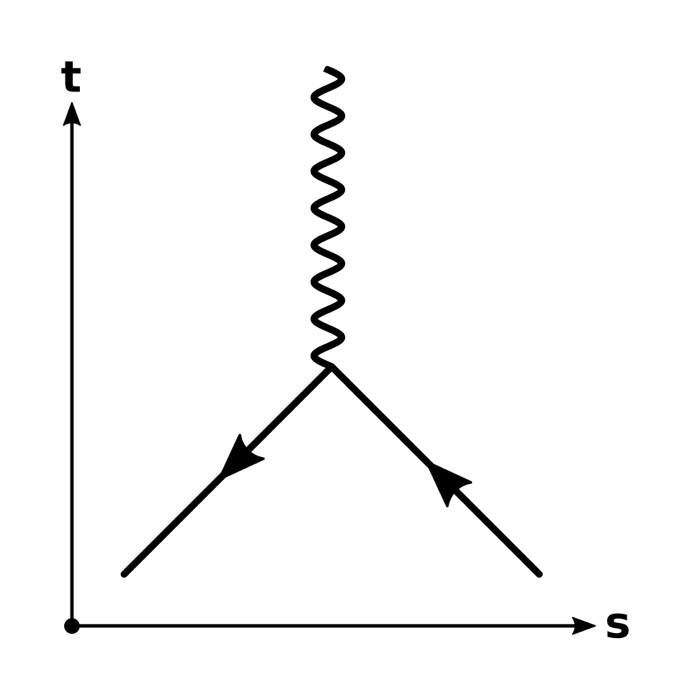
A plain line drawing on two axes, the upright one marked t for time and the flat one marked s for space. Two straight lines with arrowheads come in from the bottom left and the bottom right and meet at a single point in the middle, and from that point one wavy line runs upward. Nothing else is on the page.
A Feynman diagram, the plainest one there is: two particles come in, meet, and leave as a single wave. Time runs up the page. The two straight lines are an electron and its antiparticle arriving; the point where they touch is the moment they annihilate; the wavy line going up is the photon that is left. Nothing in the drawing is to scale and nothing in it is a measurement. Sismondo cites it for the way it travelled. It spread through the field in the 1950s because it was simple and could be read in more than one way, so schools holding quite different theories could each take it up and each mean something slightly their own by it. A shared thing that survives being understood differently is what he means by a pidgin. Drawing by Romainbehar, CC0, via Wikimedia Commons.
Example · Feynman diagrams as a pidgin

Richard Feynman's little drawings of particle interactions spread through physics in the 1950s, carried by visiting postdoctoral fellows. Sismondo's point, following David Kaiser, is that they spread because they were simple and could be read in more than one way. Different schools with different theoretical commitments picked them up, adapted them and developed local styles of using them, and they still worked as a way of communicating across those differences. He then turns the example against the concept: it seems a stretch to say theoretical physicists needed a pidgin to talk to each other, and yet that is exactly what the diagrams look like.

Boundary objects, from Susan Leigh Star and James Griesemer in 1989, put the weight on things. An object works as a bridge if it can hold the attention of different social worlds at once and stay recognisably itself in each of them.

Example · the Berkeley Museum of Vertebrate Zoology

The case Star and Griesemer built the idea on. Amateur collectors, professional scientists, philanthropists and administrators all had different visions of what the museum was for and what work mattered, which is incommensurability in miniature. What held them together was the standardised record of a specimen. The record meant something different to each group, and every group could contribute to it and use it. Nobody had to change their practice or translate anything. They coordinated through a shared object instead.

The two answers to how people across a boundary work together: a shared simplified language, and a shared object that means something different to each side. TRADING ZONE BOUNDARY OBJECT they share a language they share a thing Field A Field B A pidgin they both speak Feynman diagrams Nobody assimilates. They trade. Field A Field B One object, two readings A specimen record card Nobody translates. They both write on it. EACH SIDE IS LEFT AS IT WAS
Two ways of working across a boundary, and what they have in common. A trading zone gives the two sides a stripped-down shared language and lets them exchange without either becoming the other. A boundary object gives them one thing solid enough to stay itself in both worlds while meaning something different in each. Neither asks anybody to change what they do, which is why both work where full translation would fail. The chapter's own caution is that ideas this accommodating fit almost any case, and may be describing a difficulty smaller than it looks.

Sismondo is sceptical of both, and says so. The boundary object concept has been applied to an enormous range of things, including, within the original article alone, the museum itself, the animal species in it, the state of California and the specimen records. Engineers' sketches, the parameters of climate models, and breeds of rabbits and poultry connecting fanciers to geneticists have all been called boundary objects since.

His conclusion is the deflationary one. The sheer number and variety of these bridges suggests that coordination and communication across boundaries are common, and that a good deal of it happens by plain translation: researchers learn what colleagues in other fields know and put things in terms those colleagues can follow. Trading zones and boundary objects may therefore overstate the difficulty. Incommensurability, as it turns up in practice, is often not a serious barrier at all.

What the chapter says the book destroyed

The conclusion lines Kuhn up against four positions, three of which are in the week 2 packet.

  • Against functionalism. Scientific communities are organised around ideas and practices, from the bottom up. Functionalism had them organised around ideals of behaviour, serving an overarching goal.
  • Against positivism. Changes in theory are driven by changes of vision. Data follows: if a worldview is a theory, then data sits under theory, which is the reverse of what positivism said.
  • Against falsificationism. Anomalies are typically set aside. Only during a revolution are they used to justify rejecting a theory.
  • Against all of them. On the largest scale the history of science is a story of change. Uninterrupted progress is the story it is usually told as.

On the irrationalist reading, Sismondo is dismissive. The book was read as saying science is fundamentally irrational, or is mob rule, because it violated almost everybody's ideas about rationality and progress. Looking back, he says, it is difficult to find much irrationalism in it, and possible to read the book as fairly conservative, Steve Fuller having argued it is politically conservative as well.

And the verdict, which is oddly generous and oddly brutal at once. Few of Kuhn's specific ideas have survived fully intact. The book profoundly affected everything that came after it anyway, because what it did was create a space for studying the practices of science locally, in their own terms, with no need to score them against progress or against an ideal.

The three boxes, which are examinable and easy to skip

Sismondo's boxes are set apart from the text and carry named material. All three are inside the assigned pages.

Box 2.1The modernity of science, page 13

Derek de Solla Price's finding: science has grown exponentially for three hundred years. Its share of US gross national product doubled every 20 years. The cumulative number of journals founded doubled every 15 years, as did membership of scientific institutes and the number of people holding scientific degrees. Articles in many subfields doubled every 10 years.

The consequence is the memorable fact: between 80 and 90 per cent of all the scientists who have ever lived are alive now, and for a senior scientist, between 80 and 90 per cent of all the scientific papers ever written appeared in their own lifetime.

Why it belongs in this chapter. For a working scientist the distant past of the field is nearly irrelevant, buried under more recent work, and citation patterns show it. Price called the frequently cited network of papers at a given moment the research front, which continually picks up new papers and drops old ones. So whether or not paradigms exist as Kuhn describes them, science attends to the present and leaves its past to historians. Sismondo adds that rapid growth is also why science looks like a young person's occupation, since at any moment a disproportionate number of scientists have only just arrived.

Box 2.2Foundationalism, page 15

Foundationalism is the thesis that knowledge traces back to firm foundations, usually some combination of sense impressions and rational principles holding up everything above them. Its metaphor is a building planted in the ground: ask why you believe something and the answer is more beliefs, each brick supported by more beneath it, and the wall cannot go down forever.

Sismondo's two objections. Sense experiences are the most plausible candidate for the bottom course, but a finite collection of data points cannot determine which generalisation to believe, which is the problem of induction again. And beliefs about sense impressions are not secure either, since we routinely doubt what we see and reinterpret it in the light of what we know.

The conclusion is to abandon the metaphor. Which is why this box sits in the Kuhn chapter: if there is no floor, the question of what holds knowledge up has to be answered by something other than a foundation, and the candidate the rest of the book offers is a community.

Box 2.3The theory-dependence of observation, page 18

The claim, from Hanson and Kuhn, is that scientific observations are shaped by what the observer already believes. Sismondo reports that philosophers, psychologists and cognitive scientists broadly agree this happens, and disagree about how much it matters for understanding science.

His own move is to widen what observation means. Scientific observation is rarely one person perceiving something unaided. Much data is collected by machine and then organised by scientists to display a phenomenon publicly, and if that organising counts as observing, then observation is theory-dependent in a way nobody needs to argue about.

And the dependence runs wider still. Scientists attend to the objects that background beliefs say are worth looking at, design experiments around theoretically inspired questions, and judge what is relevant enough to remember and pass on by standards their field already holds.

If you keep one thingHalf this chapter sets out Kuhn's claim that rival paradigms have no common measure, and the other half argues that the strong version of it fails, that Kuhn himself had retreated to "difficulty of translation" by 1965, and that science holds together because its parts never change all at once.
My noteThe trap is stopping at page 16. Everything up to there is Kuhn and reads like a summary; everything after is Sismondo taking the strong claim apart and introducing trading zones and boundary objects, which are the two terms with named authors attached and the likeliest short-answer material in the whole chapter. Learn Galison with trading zones and Star and Griesemer with boundary objects.

BACKGROUNDKuhn himself, behind the chapter

Thomas Kuhn, The Structure of Scientific Revolutions, 1962
Contextnot the assigned text
What this isKuhn's own argument, which the assigned chapter is about and mostly assumes. None of it is attributed to Sismondo, and the examples here are not his. The chapter itself is narrated above, with its page numbers. Read that one for the exam and this one for the background it leans on.

Why does a scientific community change its mind, if not because the evidence made it?

The book, and the joke about where it was published

Thomas Kuhn was an American physicist who moved into the history of science, and in 1962 he published The Structure of Scientific Revolutions. It is short, it is the most cited book of its century in the humanities and social sciences, and it put the word paradigm into ordinary English, where it is now used by people selling software.

Where it came out is the joke. It was published as a monograph inside the International Encyclopedia of Unified Science, which was the Vienna Circle's own publishing project. Chapter 9 of last week's packet is the Vienna Circle manifesto, arguing that science is one unified structure built up from verified observation statements. Kuhn's book, which says science does not build up and observation statements are not neutral, came out as a volume of their encyclopedia. The people who commissioned it published the thing that undid it.

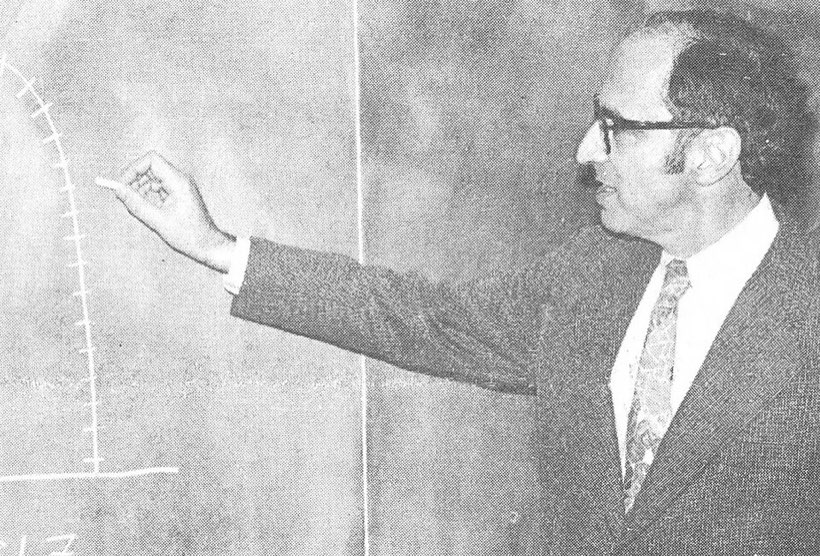
A man in a suit and tie with heavy dark-framed glasses, standing at a blackboard in profile, one hand raised to a curve he has chalked on it.
Thomas Kuhn in 1977, fifteen years after the book. He trained as a physicist and moved into history, and by this date he had spent a decade telling people they had misread him. What they had taken from it, and what he had actually written, are set out below. Photograph by Bob Bielk, public domain, via Wikimedia Commons.

What people took from it, and what he wrote

What the book was read as saying was that science is not rational. That a paradigm wins by fashion, politics or the deaths of the people who disagree, that one is as good as another, and that there is no such thing as getting closer to the truth. That reading is why "paradigm shift" now means any change of mind at all, and it is the reading Kuhn spent the rest of his life denying.

What he wrote is narrower. There are real reasons for preferring one theory to another, and he named five: accuracy, consistency, breadth, simplicity and fruitfulness. His claim is that those five do not settle it, because two people can weigh them differently and neither is being stupid. One prefers the theory that fits the measurements better, the other the theory that covers more ground, and there is no further rule that says which of them is right. So the choice is reasoned and underdetermined at the same time, which is a long way from irrational.

Progress he never denied. Later science solves more puzzles, more precisely, than earlier science. What he denied was the shape the textbooks give it.

The textbook shape is a wall. Each generation lays a course of bricks on the one below, nothing already laid is ever taken out, and the wall only gets higher. On that picture Newton is still standing inside Einstein, as the special case you get at low speeds.

Kuhn says bricks come out. Newtonian mass is a fixed quantity that a body simply has; relativistic mass changes with speed and converts into energy. They are not the same quantity with a correction term, so the sentence "mass is conserved" is not a true claim that Einstein kept and refined. It was thrown away and something else was put in its place that happens to give nearly the same numbers when things move slowly. Phlogiston went out of the wall entirely. Caloric, the weightless fluid heat was made of, went out. The crystal spheres carrying the planets went out. A wall that loses courses is not a wall being built up, and that is the whole of what "science does not accumulate" means.

Normal science: most scientists are not testing anything

Kuhn's first move is to describe what scientists actually do all day, which is not what the textbook picture says. The textbook picture is that a scientist proposes a bold conjecture and tries to refute it. Kuhn looked at the historical record and found that almost nobody does this almost ever.

What they do instead he calls normal science: solving puzzles inside a framework that is not itself in question. Measure this constant more precisely. Extend the theory to one more case. Build an instrument that gets at the quantity the theory says exists. The framework is the tool they work with.

Puzzle is his word and it is deliberate. A puzzle is something you already believe has a solution, and the interest is in whether you are clever enough to find it. A crossword has an answer. If you fail, the crossword is not discredited, you are. Normal science works the same way, and that is why a failed experiment is normally read as a failed experimenter.

Example · what this feels like from inside

In 2011 the OPERA experiment at Gran Sasso measured neutrinos arriving from CERN about sixty nanoseconds earlier than light would have. Faster than light is not a small anomaly; it contradicts special relativity. The team did not announce a revolution. They published the measurement and asked the community to find their mistake, and said so explicitly. Six months later the mistake was found: a fibre-optic cable was not fully screwed in, and a clock oscillator was running fast. The paradigm was never on trial. The cable was.

Paradigm, and why the word is slippery

Kuhn used paradigm in more senses than he meant to. A critic named Margaret Masterman went through the book and counted twenty-one distinct uses. Kuhn accepted the complaint and in a postscript split it in two, and those two are the ones to hold.

  • The disciplinary matrix. Everything a scientific community shares: the equations it writes down, the models it pictures things with, the values it uses to judge a good theory, the list of problems it thinks are worth solving. Not a theory, a whole working culture.
  • The exemplar. A concrete problem already solved, which students work through in training and then imitate for the rest of their careers. The inclined plane. The hydrogen atom. Kuhn said this was the sense he cared about most, and it is the one usually forgotten.

The exemplar sense is the interesting one, because it says a scientist is trained less by learning rules than by copying worked examples. Nobody can state the rules of their own field completely. What they have is a stock of cases and a feel for which new problem resembles which old one. That is a craft, and it is learned the way crafts are learned, which puts Kuhn unexpectedly close to the Greek technē in last week's Schadewaldt chapter.

Anomaly, crisis, revolution

Anomaly. A result the framework cannot digest. Most anomalies get absorbed, adjusted for, or put on a shelf marked "not yet", and there is a good reason for it: a framework that collapsed at the first awkward result would never get any work done.

Crisis. Anomalies accumulate at a point the community cares about, the fixes start looking like patches, and confidence goes. Kuhn's claim is that this is a state of the community. The same anomalies could have been known for decades and the crisis arrives when confidence does.

Revolution. A new framework takes over. Not by being added to the old one, but by replacing it, and Kuhn's strongest claim is that the new one does not contain the old as a special case in the way textbooks pretend.

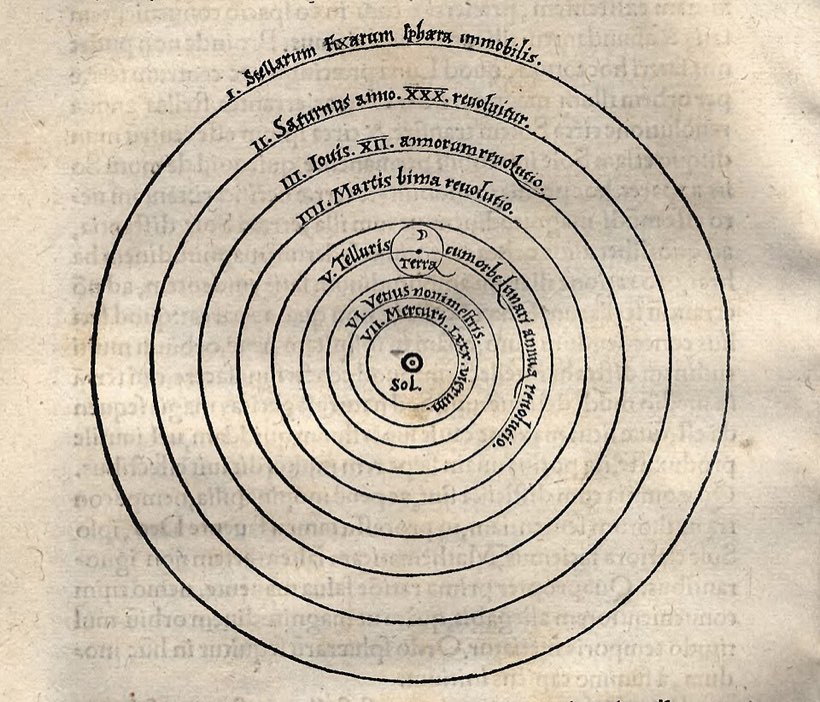
A page from a sixteenth-century printed book showing seven nested circles drawn around a small sun at the centre, each ring labelled in Latin with the name of a planet and the length of its orbit, and the moon drawn on a small circle beside the earth.
The diagram from Copernicus, De revolutionibus orbium coelestium, 1543. Kuhn wrote a whole book about this one case before he wrote the famous one. The detail that matters for the argument: this system was about as accurate as the one it replaced, about as complicated, and still needed circles inside circles to make the numbers come out. It did not win by predicting better, which is why Kuhn went looking for what else decides. Public domain, via Wikimedia Commons.
Kuhn's cycle drawn as a line that breaks: two flat runs of puzzle solving with a step between them. NORMAL SCIENCE ANOMALY CRISIS REVOLUTION NORMAL SCIENCE, NEW PARADIGM the step goes sideways
The shape of the claim. Five stages left to right: normal science, anomaly, crisis, revolution, then normal science again under a new paradigm. Two long flat runs of puzzle solving with a break between them. The textbook picture is one line climbing steadily; Kuhn's is a line that stops and restarts somewhere else, which is why he denies that science accumulates.

Incommensurability, the claim that causes all the trouble

Incommensurable means there is no common measure. Kuhn borrowed it from geometry, where the side and the diagonal of a square cannot both be counted in whole units of the same ruler. Applied to paradigms it means you cannot settle the contest by totalling the evidence, because three things move at once.

  • The words change meaning. Mass in Newton is conserved and independent of speed. Mass in Einstein is not. The same word, two different quantities, so a sentence with "mass" in it is not the same claim in both.
  • The list of good questions changes. Asking why a body keeps moving is a serious question before Newton and a confused one after him.
  • The standards change. What counts as a satisfying explanation is set by the paradigm, so each side scores itself well by its own rules.

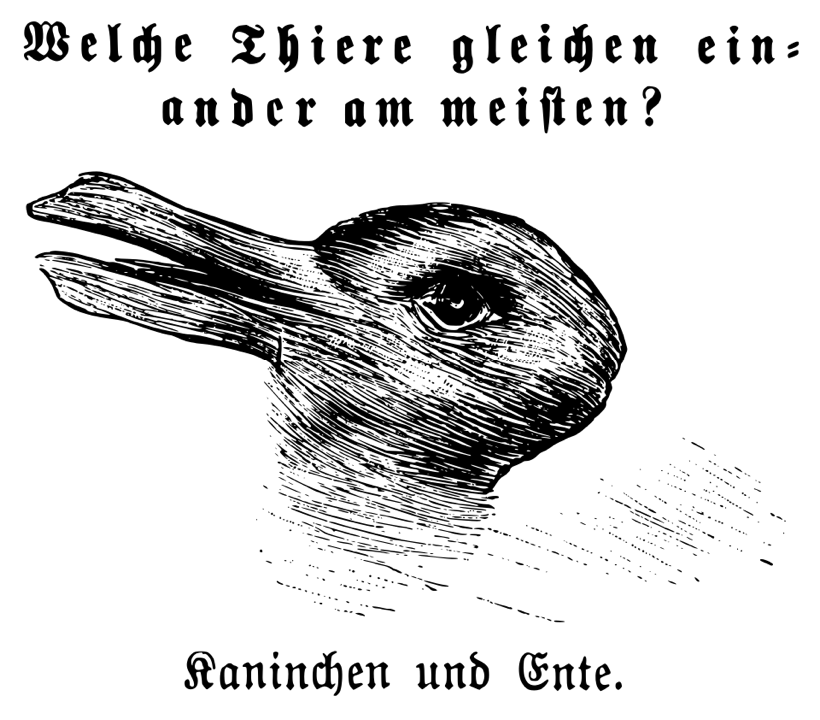
Kuhn's own picture for it is the duck and the rabbit. One set of lines, two ways of seeing, and no third way of seeing it that is neutral between them. You can flip between them and you cannot hold both at once, and nothing in the drawing itself settles which one is correct. A scientist who moves to a new paradigm does not get a better view of the same thing; the thing looks different.

A magazine page in blackletter type. The heading asks, in German, which animals most resemble one another. Below it an engraved animal head reads either as a duck facing left, the two long shapes being its bill, or as a rabbit facing right, the same two shapes being its ears. The line under it names both.
The duck and the rabbit, from the German humour magazine Fliegende Blätter in 1892. The heading asks which animals most resemble one another and the line below answers, rabbit and duck. Kuhn borrows the figure from psychology to say what a change of paradigm is like: the lines on the page never move, what changes is what they are a picture of, and there is no position outside the two from which to check. Public domain, via Wikimedia Commons.

What Kuhn did not say, and spent thirty years insisting he had not said, is that theory choice is irrational or that anything goes. His position is that there are good reasons, that they are real, and that they do not add up to a proof, so two careful people can weigh them differently. He hated being called a relativist.

Example · the people who never crossed over

Joseph Priestley isolated oxygen in 1774 and called it dephlogisticated air. Phlogiston was the substance eighteenth-century chemistry thought fire was made of: everything burnable was held to contain it, burning was held to be the stuff escaping, and a candle was held to go out under a jar because the trapped air had taken up all the phlogiston it could hold. On that account Priestley had not found a new gas, he had found air with the phlogiston taken out, which is why he named it that. Lavoisier's account reversed the direction: burning is the thing taking oxygen up out of the air. Priestley went to his death in 1804 still holding the older view, having watched the entire field move without him. Alfred Wegener proposed continental drift in 1912 with the fit of the coastlines, matching fossils and matching rock beds, and was dismissed for half a century mostly because he had no mechanism. He died on the Greenland ice in 1930. Sea floor spreading arrived in the 1960s and plate tectonics became the framework of the whole science, thirty years too late for him to see it. Max Planck put the general rule bluntly: a new scientific truth does not win by convincing its opponents, it wins because the opponents eventually die and a new generation grows up with it.

Why the course sets this here

Kuhn moves the unit of analysis from the method to the community. Before him, the question was what rule separates science from everything else, which is the Vienna Circle question. After him, the question is what a trained group of people accepts, why they accept it, and what would make them stop. That is a question about people, and people can be studied by sociologists.

What a philosopher of science examines, before Kuhn and after: on the left a statement and its evidence, on the right a community and its training. BEFORE AFTER KUHN Is this sentence science? Why does this group accept it? A statement A community Its evidence Its training Science, or not What it accepts THE UNIT
The question changes what you have to go and look at. On the left the object of study is a sentence, and the job is to check it against the evidence and rule on it. A philosopher can do that from a desk. On the right the object of study is a group of people: what they were trained on, which worked examples they copy, what they will count as a solved problem. That is not something you can rule on. It is something you have to go and watch, and watching people is what sociologists and anthropologists do, which is how a question in philosophy turned into a research programme in the social sciences.

Which is exactly where the course goes next. Week 4 is the social construction of scientific knowledge, and the field that grew out of the door Kuhn opened is the one whose textbook this chapter comes from. Sismondo is writing an introduction to science and technology studies, and this chapter is the origin story of the discipline he is introducing.

If you keep one thingScientists spend nearly all their time solving puzzles inside a framework they are not testing, and when the framework changes it gets replaced, because the two frameworks do not share a ruler to be measured against.

My noteEleven pages, so read it properly. The three words an exam can ask for by name are normal science, paradigm and incommensurability, and the one people get wrong is paradigm, because they give the vague sense and miss the exemplar.
For the curiousnone of this is on the exam
He got the idea while trying to understand why Aristotle looked stupid

Kuhn was a physics graduate student asked to teach a science course for humanities students, which meant reading Aristotle's physics. It looked like nonsense to him: bad mechanics, wrong in ways a first-year could see. Then, at his desk one summer day in 1947, it reorganised itself. Aristotle was not doing bad Newtonian mechanics, he was doing something else entirely, with a different question and a different notion of motion, and inside that scheme he was not stupid at all. Kuhn described it as a sudden change of shape, and the whole book comes out of that afternoon.

The word paradigm escaped and now sells software

Before 1962 the word meant a grammatical model, the table of endings you learn when you conjugate a verb. Kuhn's usage leaked into management, marketing and self-help, where a paradigm shift now means any change of mind at all. Kuhn lived to see this and was not pleased. He is one of a very small number of people who put a word into everyday English and then had to watch what happened to it.

The other Kuhn book is about the Copernican revolution

The Copernican Revolution came out in 1957, five years earlier, and it is the case study the famous book generalises from. The detail worth knowing: Copernicus did not make better predictions than Ptolemy. His system was about as accurate and about as complicated, still used circles, and still needed epicycles.

What it won on instead. Retrograde motion, the loop a planet appears to make against the stars when it seems to reverse and go back on itself, falls out of a moving earth on its own, where Ptolemy had to build a circle-on-a-circle for each planet to produce it. The order of the planets and their distances from the sun also fall out, where Ptolemy could put them in any order he liked and nothing changed. And it dropped the equant, a device Ptolemy used that Copernicus thought cheated. None of that is a prediction. It is tidiness, and a system that answers questions the other one could only be told the answers to.

Then two things arrived that did not exist in 1543. Kepler replaced the circles with ellipses in 1609 and the predictions finally did get better. Galileo turned a telescope on Venus in 1610 and found it goes through phases like the moon, which the Ptolemaic arrangement cannot produce. The argument took about a century and was settled by instruments nobody had when it started.

Popper and Kuhn argued in public, and the argument is still running

Karl Popper said science is what can be falsified: a real theory forbids something, and you go looking for the thing it forbids. Kuhn said that describes almost nothing anyone actually does, because a working scientist who gets a contrary result assumes their apparatus is wrong. They met at a colloquium in London in 1965, and the volume that came out of it, Criticism and the Growth of Knowledge, is one of the standard fights in the field. Imre Lakatos spent the rest of his career trying to build something that kept Popper's standards and Kuhn's history at the same time.

There is a book called The Poker, and it is about a different fight

A different fight, with the same cast. In 1946 Popper gave a talk at Cambridge and Wittgenstein, who was chairing, picked up a fireplace poker. The two men argued, the poker was waved, and Wittgenstein walked out. Everyone present remembered it differently and nobody agrees on what was said. Two journalists wrote a whole book, Wittgenstein's Poker, about ten minutes in a room. Philosophy of science has better anecdotes than it is given credit for.

CH 54Panopticism

Michel Foucault, from Discipline and Punish, 1975
Read properly11 pp text · 3 pp notes and references
pdf pp. 85 to 98 of 98 · text 85 to 95, notes and references 96 to 98 · book pp. 654 to 667

What kind of power works by making you watch yourself?

He begins with a plague town, and the detail is the argument

A seventeenth-century town under plague. It is closed and cut into quarters and streets, each under an official who may not leave for the duration. Everyone is shut in their house on pain of death.

Every inhabitant is registered by name, age and sex regardless of station. Copies of the register go to three places: the quarter's intendant, the town hall, and the official who calls the roll daily at each window. Each person has to appear and answer to their name. Everything observed on the rounds is written down and passed up the chain: deaths, illnesses, complaints, irregularities. Magistrates control all medical treatment, and no other practitioner may treat, no apothecary prepare medicine and no confessor visit a sick person without written permission.

Five or six days in, the houses are purified one at a time. Everyone leaves. Furniture is raised off the floor, windows, doors and even keyholes are sealed with wax, and perfume is burned inside. The men who did the work are searched on the way out, to prove they carry nothing they did not bring in.

ContextWhat "purified" meant, and why it took that form

Nobody in the seventeenth century knew about bacteria. The plague was understood as corrupted air, the same miasma theory that turns up in the Comte chapter two hundred years later. On that account the poison hangs about in a sick house and soaks into anything porous: bedding, clothing, wall hangings.

Every step follows from that belief. Burning perfume, usually sulphur, juniper or vinegar, was meant to correct the bad air with strong good air. Sealing the keyholes kept the fumigation smoke inside long enough to reach everything. Raising the furniture let the smoke underneath. And searching the workers did two jobs at once: it stopped looting, and it stopped infected goods leaving the house.

The theory was wrong and some of the practice worked anyway, because emptying and fumigating a house also kills fleas and rats. Which is the same accident as Bazalgette's sewers in the Comte chapter: a false account pointing at a useful action.

Foucault's interest is elsewhere. He is not asking whether the medicine worked. He is pointing at the paperwork: the register, the roll call, the daily written report. Those are the parts that outlived the plague and became how schools and clinics run.

What he extracts from it: the definition of discipline

Foucault's summary is the sentence to underline. An enclosed, segmented space, observed at every point, every individual fixed in place, the slightest movement supervised, all events recorded, and an uninterrupted work of writing linking the centre to the edges. He calls it a compact model of the disciplinary mechanism.

Discipline is a technical term for him, and it names a way of exercising power that works by sorting: dividing a crowd into individuals, assigning each one a place, a timetable and a record, and then watching. Its characteristic operation is analysis, in the literal sense of breaking a thing into parts. The plague is a mixture, bodies and diseases and rumours confused together, and the answer to a mixture is to separate it into countable individuals.

The contrast he draws next is the most quotable thing in the essay. Literature has always dreamed of plague as carnival: laws suspended, prohibitions lifted, masks off, bodies mingling, everyone abandoning the identity they were assigned. There is also a political dream of the plague, and it is the exact reverse of the carnival. Regulation reaching into the smallest details of daily life, and the assignment to every individual of a true name, a true place, a true body, a true disease.

Two historical models, two techniques. The leper was excluded, in one massive binary cut, exile, and then left to a mass in which telling one person from another was pointless. The plague victim was included and sorted: multiple separations, individualising distribution, surveillance in depth. Modern institutions inherit the second technique while still using the first's language of casting out.

Bentham's Panopticon, and why it works

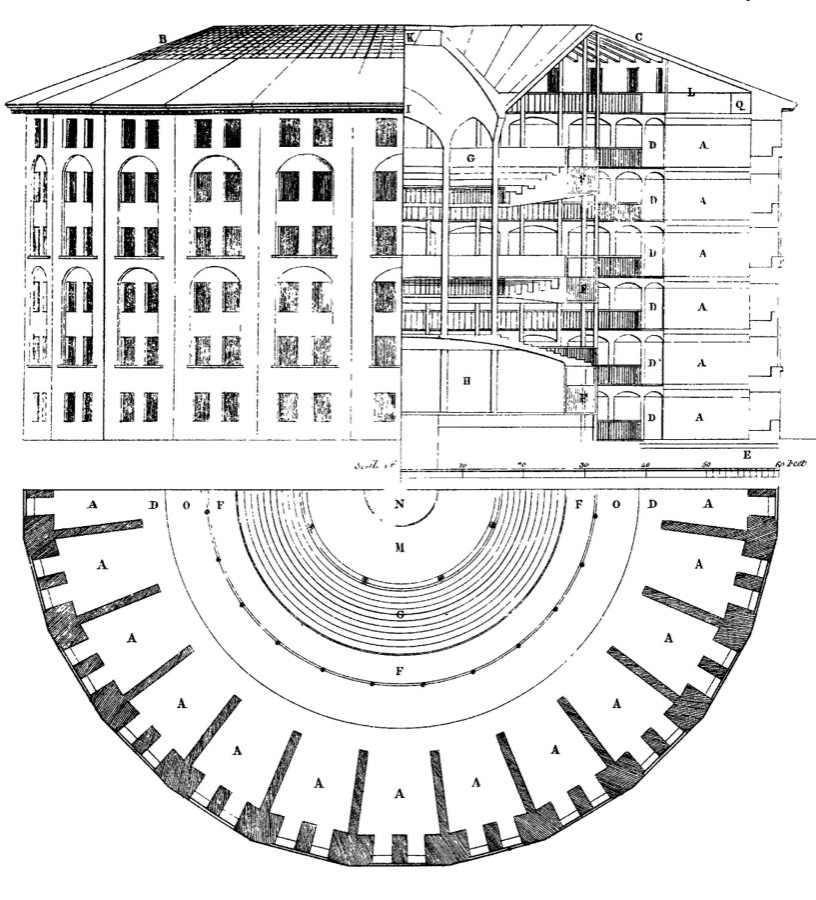
In 1787 Jeremy Bentham designed a building: a ring of cells around a central tower. Each cell runs the full depth of the building and has a window at the outer wall and one at the inner, so the occupant appears from the tower as a perfectly legible silhouette, backlit. The tower has blinds and angled partitions, so its interior stays dark.

An engraved sheet in two parts: at the top a five-storey prison wall cut open to show cells stacked around the outer ring facing a tower in the middle, and below a half-circle floor plan with single cells lettered A along the outer wall and dividing walls running inward to concentric rings at the centre.
Elevation, section and plan of Bentham’s panopticon, drawn by Willey Reveley in 1791. The cutaway at the top has five storeys of cells stacked around the outer wall, each lit by a window behind it, so a prisoner appears from the centre as a dark shape against daylight. In the plan below, the inspector’s lodge fills the concentric rings at the middle, screened so that nobody in a cell can tell whether anyone is watching, which is the condition Foucault says makes prisoners police themselves. Public domain, via Wikimedia Commons.

The consequences follow mechanically:

  • The inmate is seen and never sees. He can never verify whether anyone is in the tower at this moment.
  • So he behaves at all times as if he were being watched, since the cost of being wrong is too high. Visibility itself becomes the trap.
  • The prisoner takes over his own surveillance. The power no longer needs to be applied to him, because he is applying it to himself.
  • Which makes it automatic, continuous and cheap. Fewer guards, no chains, no violence, no audience. Bentham's phrase for the effect is power of mind over mind.

The crucial move: it is a diagram

Foucault insists the Panopticon must not be read as a dream building. It is a diagram: a mechanism of power reduced to its ideal form, stripped of any particular use, a figure of political technology that can and must be detached from any specific application.

Which is why he lists its uses in a single breath: reform prisoners, treat patients, instruct schoolchildren, confine the insane, supervise workers, put beggars to work. Wherever a task has to be imposed on a multiplicity of people, the schema applies. He also notes Bentham's own sales pitch, quoted for its enthusiasm: morals reformed, health preserved, industry invigorated, instruction diffused, public burdens lightened, economy set upon a rock, all by a simple idea in architecture. A reformer proposed this as reform.

And the final point is the subtle one. This power is not a weight pressing from outside on a function it interferes with. It is woven into the function so intimately that it increases that function's efficiency while multiplying its own points of contact. The school teaches better because of it. That is what makes it hard to argue with.

Why this belongs in a course about scientific method

Look at what the plague town and the Panopticon are both made of: registers, roll calls, case notes, timetables, examinations, files. Every one of those is simultaneously an instrument of knowledge and an instrument of control. You find out what a person is like by the same act that fixes them in place.

Foucault's historical claim is that the human sciences were born inside exactly these institutions: psychiatry, criminology, the study of childhood and education. Prisons, clinics, asylums and schools were the first places with captive populations that could be measured over time. So knowledge about people did not arrive from outside and get applied to institutions. It was produced by them. Once that is on the table, "whose knowledge counts" stops being a philosophical curiosity and becomes a political question, which is where Weeks 4 through 9 of the course begin.

If you keep one thingThe point of the tower is that you cannot tell whether anyone is watching, so you do the watching for them.

My noteHardest prose in the packet, and it punishes stopping. Keep moving, because he restates every difficult point two paragraphs later in plainer words.
For the curiousnone of this is on the exam
Bentham never got one built, and it nearly ruined him

Jeremy Bentham spent roughly two decades and a great deal of his own money trying to persuade the British Parliament to let him build and personally run a Panopticon prison. Land was bought and committees met for years without producing a building. In 1813 Parliament voted him £23,000 in compensation and the scheme died. The most famous building in modern political theory was never constructed by the man who designed it.

Bentham himself is on display in a cabinet in London

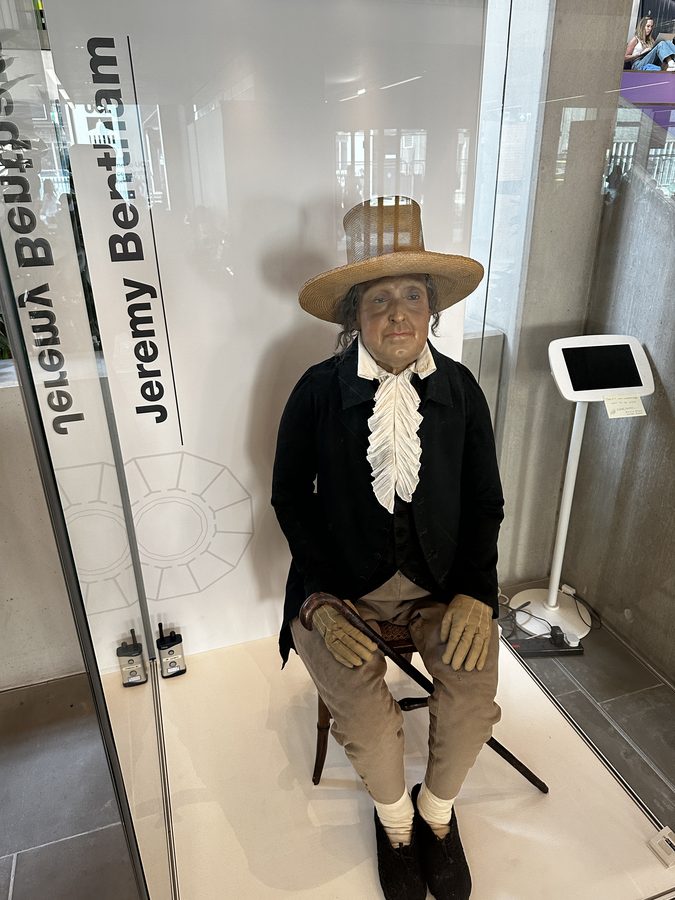
His will instructed that his body be dissected in front of friends, then preserved, dressed in his own clothes and kept as an Auto-Icon. It is at University College London to this day: his actual skeleton, padded out, in his coat and hat. The preservation of the head went badly, so a wax one was made, and the real mummified head was kept separately and has an undignified history involving students. A man who believed a body should be useful after death is in a box, being looked at forever. Foucault would have enjoyed it.

A seated figure in a black tailcoat, pale breeches and a wide straw hat, gloved hands resting on a walking stick across the knees, enclosed on every side by a tall glass case in a modern concrete building.
Jeremy Bentham’s Auto-Icon in its case at University College London, photographed in April 2026. Bentham’s will asked that his body be preserved, dressed in his own clothes and seated in a case where anyone could come and look at him, and the head is wax because the attempt on the real one left it disfigured. The man who designed a building around permanent inspection is the figure under glass here, with students walking past him all day. Photograph by Matt Brown, CC BY 4.0, via Wikimedia Commons.
One was built in Cuba, and Castro was locked in it

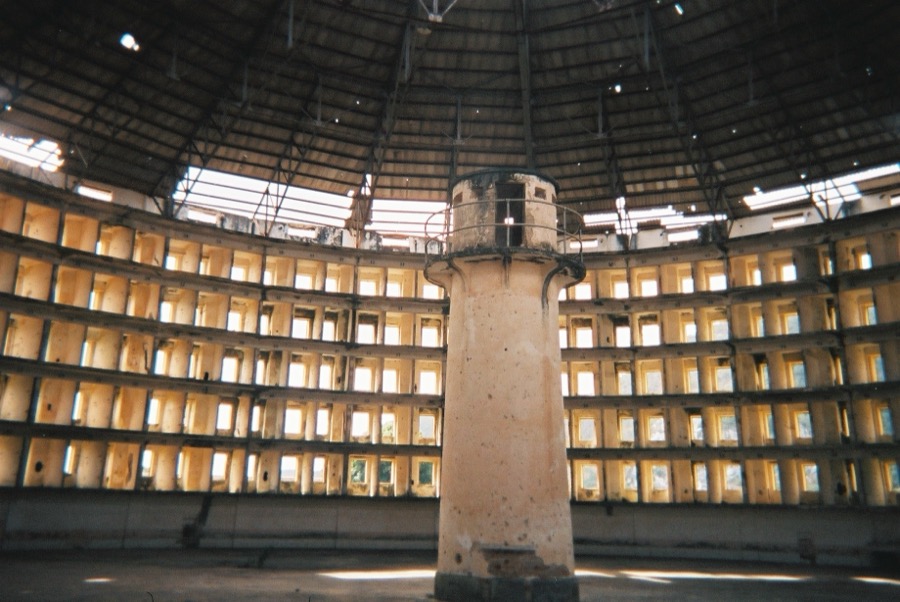
The Presidio Modelo on the Isla de la Juventud was constructed between 1926 and 1928: five enormous circular blocks, each with a watchtower at the centre, exactly to Bentham's plan. Fidel Castro was imprisoned there from 1953 to 1955 after the Moncada attack. It closed in 1967 after riots and hunger strikes over conditions, and stands empty as a museum. Photographs of the interior are the single most useful thing you can look at before reading this chapter.

Looking across the floor of a circular prison block: five tiers of small square cell openings curve right around the wall, all of them facing a plain concrete tower standing alone in the centre.
Inside one of the circular cell blocks at the Presidio Modelo, Isla de la Juventud, Cuba. This is Bentham’s drawing built at full size and filled with people: every cell faces the tower, and the tower’s windows tell a prisoner nothing about whether a guard is behind them, so a man in a cell had to act all day as though he were being watched. Photograph by Friman, CC BY-SA 3.0, via Wikimedia Commons.
A warning about the first chapter of the book

Discipline and Punish opens with several pages on the public torture and execution of Robert-François Damiens in Paris in 1757, in clinical and unbearable detail. It then prints a dull timetable from a young offenders' prison eighty years later, with no comment between them. Hour by hour: rise, prayer, work, meal, work, school. That juxtaposition is the book's whole argument and is why people find it unforgettable. It is not in your extract. It is extremely graphic, so approach it knowing what it is.

Foucault was a celebrity, and he looked like one

Bald, white polo necks, a public intellectual in a country that still produces them. He held a chair at the Collège de France, where by tradition lectures are free and open to anyone, and his were so oversubscribed that people arrived hours early with tape recorders. He was tear-gassed at demonstrations, campaigned for prisoners' rights and founded a prisons information group, and helped shelter Vietnamese refugees. He died in 1984 of an AIDS-related illness, among the first prominent French public figures to do so, at a moment when the illness was barely speakable. A life spent writing about who gets classified, confined and spoken about ended with an unbearable symmetry.

This chapter is why you can argue about your phone

Almost every current argument about surveillance runs on machinery built here. Workplace productivity monitoring. Exam proctoring software that watches students through their webcams. Social media as a place where people perform for an audience they cannot see. Shoshana Zuboff's The Age of Surveillance Capitalism (2019). Foucault's point was never that someone is spying on you. It is that when you cannot tell whether you are being watched, you start managing yourself, and at that moment nobody has to do anything at all.

Glossary

Every term in this guide, defined14 of them

KuhnSismondo ch. 2

normal science
What scientists do nearly all the time: solving puzzles inside a framework that is not itself being tested. A failure counts against the scientist.
puzzle
Kuhn's deliberate word for a normal-science problem. Something already believed to have a solution, so failing to find it discredits you.
paradigm, as disciplinary matrix
Everything a scientific community shares: its equations, its models, its values, and its list of problems worth solving.
paradigm, as exemplar
A concrete solved problem that students work through and then imitate. Kuhn said this was the sense he cared most about.
anomaly
A result the framework cannot digest. Most are absorbed, adjusted for, or shelved.
crisis
Anomalies pile up where the community cares, the fixes start looking like patches, and confidence goes. A state of the community, arriving when confidence does.
revolution
One framework replacing another. It does not get added on top.
incommensurability
No common measure between two paradigms. The words change meaning, the good questions change, and the standards for a good answer change, so the evidence cannot simply be totted up.

Foucaultch. 54

discipline
Power that works by sorting: dividing a crowd into individuals, giving each a place, a timetable and a record, then watching. Its operation is analysis, breaking a thing into parts.
the plague town
The seventeenth-century lockdown Foucault opens with. Registers, daily roll calls, written reports upward. He calls it a compact model of the disciplinary mechanism.
the leper and the plague victim
Two techniques. The leper is excluded in one binary cut. The plague victim is included and sorted. Modern institutions inherit the second.
the Panopticon
Bentham's 1787 design: a ring of backlit cells around a dark central tower, so the inmate is seen and can never check whether anyone is looking.
a diagram of power
Foucault's key move. The Panopticon is a mechanism stripped of any particular use, detachable from prisons and droppable into schools, clinics and workshops.
power of mind over mind
Bentham's own phrase for the effect.
Where this goes. Week 3 of thirteen. The rest of the term is the argument these two set up:
Week 4
The social construction of scientific knowledge, which is Kuhn's community studied directly
Weeks 5 to 7
Feminist epistemology and standpoint theory; science, gender and the body · Exam 1, Wed 7 Oct, 30%
Weeks 8 to 9
Feminist philosophy of disability; embodiment and the social model · Exam 2, Wed 11 Nov, 30%
Weeks 10 to 12
Animal minds, human and non-human
Week 13
Review and exam prep · Final, 40%, date set by the Registrar
Source. Sergio Sismondo, An Introduction to Science and Technology Studies, 2nd ed., Wiley-Blackwell 2010, chapter 2, pages 12 to 22, through the uOttawa library. Michel Foucault, "Panopticism", chapter 54 of Week 1, Intro to History of PHILOSOPHY OF TECHNOLOGY.pdf on Brightspace, from Robert C. Scharff and Val Dusek (eds.), Philosophy of Technology: The Technological Condition, An Anthology, 2nd ed., Wiley-Blackwell 2014, pages 654 to 667. Scope, dates and course thesis from the Brightspace module description, the PHI2394-B00 course outline and the first-class slides.
Lecture notes